

Witr Prayer · UK Guide
Dua e Qunoot: Arabic Text, Meaning & How to Recite It
You're stood in the third rak'ah of Witr, hands raised, and the words just stop coming. Maybe you learned one version at the masjid and a different one from your nan — and you're not sure which one is "right." If that's you, you're not alone.
Quick Answer
Dua e Qunoot is a short supplication recited standing in the final rak'ah of Witr prayer. The Prophet ﷺ personally taught one version to his grandson, Hasan ibn Ali, asking Allah for guidance, well-being and protection. Hanafi communities recite a related version traced back to the time of Umar ibn al-Khattab. Both are authentically sourced, and reciting it is Sunnah rather than compulsory.
A Note Before We Go Further
This article is researched against primary hadith and fiqh sources, but it isn't a substitute for a qualified local Imam or scholar. Where your masjid's practice differs from what's written here, follow your Imam.
The two texts, side by side
Most articles online show you one version of Dua e Qunoot and never mention there's a second, equally authentic one. Here are both, so you know exactly what you're reciting and why.
Version 1 — Taught to Hasan ibn Ali
Allahumma-hdini fiman hadayt, wa 'afini fiman 'afayt, wa tawallani fiman tawallayt, wa barik li fima a'tayt, wa qini sharra ma qadayt, fa innaka taqdi wa la yuqda 'alayk, wa innahu la yadhillu man walayt, wa la ya'izzu man 'adayt, tabarakta Rabbana wa ta'alayt.
"O Allah, guide me among those You have guided, grant me well-being among those You have granted well-being, take me into Your care among those You have taken into Your care, bless me in what You have given me, and protect me from the evil of what You have decreed. You alone decree, and none can decree against You. Whoever You befriend is never humiliated, and whoever opposes You is never honoured. Blessed are You, our Lord, and Exalted."
Sunan Abi Dawud 1425 · Jami` at-Tirmidhi 464 — Sahih (al-Albani)Version 2 — The Hanafi Text
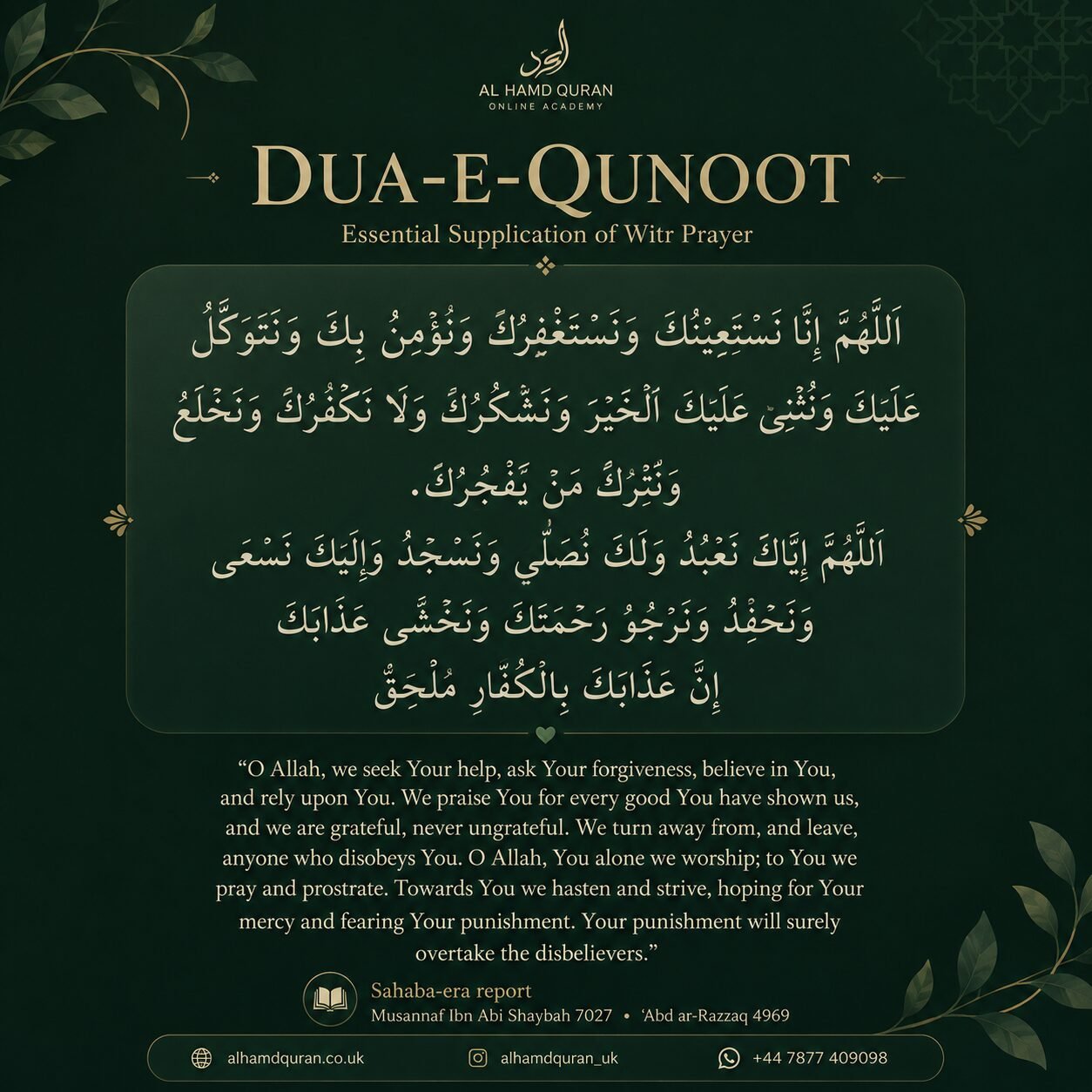
Allahumma inna nasta'eenuka wa nastaghfiruka wa nu'minu bika wa natawakkalu 'alayka, wa nuthni 'alaykal khayr, wa nashkuruka wa la nakfuruka, wa nakhla'u wa natruku man yafjuruka. Allahumma iyyaka na'budu wa laka nusalli wa nasjudu, wa ilayka nas'a wa nahfid, wa narju rahmataka wa nakhsha 'adhabaka, inna 'adhabaka bil-kuffari mulhiq.
"O Allah, we seek Your help, ask Your forgiveness, believe in You, and rely upon You. We praise You for every good You have shown us, and we are grateful, never ungrateful. We turn away from, and leave, anyone who disobeys You. O Allah, You alone we worship; to You we pray and prostrate. Towards You we hasten and strive, hoping for Your mercy and fearing Your punishment. Your punishment will surely overtake the disbelievers."
Sahaba-era report — Musannaf Ibn Abi Shaybah 7027 · 'Abd ar-Razzaq 4969That second source line matters more than it looks. Version 2 isn't a hadith of the Prophet ﷺ in the same direct sense as Version 1 — it's a report of what the Companions themselves recited. That doesn't make it weaker. Hanafi fiqh has built on Companion practice for centuries, and both texts are accepted across the four Sunni schools.
So which one should I actually recite?
If your masjid or family taught you Version 2, keep reciting it — it's standard Hanafi practice across the UK's South Asian Muslim communities, and it's well sourced. If you were taught Version 1, that's the text with the most direct route back to the Prophet ﷺ himself. Scholars including Ibn 'Uqayl al-Hanbali held that combining both — Version 1 as the core, with Version 2 added — is also acceptable.
Which raises a fair question: if two wordings are both authentic, why does any one mosque insist on only one? Mostly it's about consistency in congregational prayer, not because the other version is wrong.
Word-by-word breakdown (Version 1)
Useful if you're memorising from scratch, or helping a child learn it phrase by phrase.
| Arabic | Transliteration | Meaning |
|---|---|---|
| اللَّهُمَّ | Allahumma | O Allah |
| اهْدِنِي | ihdini | guide me |
| فِيمَنْ هَدَيْتَ | fiman hadayt | among those You have guided |
| وَعَافِنِي | wa 'afini | and grant me well-being |
| فِيمَنْ عَافَيْتَ | fiman 'afayt | among those You have granted well-being |
| وَتَوَلَّنِي | wa tawallani | and take me into Your care |
| فِيمَنْ تَوَلَّيْتَ | fiman tawallayt | among those You have taken into Your care |
| وَبَارِكْ لِي | wa barik li | and bless me |
| فِيمَا أَعْطَيْتَ | fima a'tayt | in what You have given |
| وَقِنِي شَرَّ | wa qini sharra | and protect me from the evil |
| مَا قَضَيْتَ | ma qadayt | of what You have decreed |
| إِنَّكَ تَقْضِي | innaka taqdi | for indeed You decree |
| وَلاَ يُقْضَى عَلَيْكَ | wa la yuqda 'alayk | and none can decree against You |
| وَإِنَّهُ لاَ يَذِلُّ | wa innahu la yadhillu | and none is humiliated |
| مَنْ وَالَيْتَ | man walayt | whom You have befriended |
| وَلاَ يَعِزُّ | wa la ya'izzu | nor is honoured |
| مَنْ عَادَيْتَ | man 'adayt | whom You have opposed |
| تَبَارَكْتَ رَبَّنَا | tabarakta Rabbana | Blessed are You, our Lord |
| وَتَعَالَيْتَ | wa ta'alayt | and Exalted |
Step by step: when and how to recite it in Witr
This is the Hanafi method, which most UK mosques will be familiar with.
- Pray the first two rak'ahs of Witr as normal, then stand for the third and final rak'ah.
- Recite Surah al-Fatiha and a second surah, just as in any rak'ah.
- Say "Allahu Akbar" and raise your hands to shoulder height — before going into ruku'.
- Recite the qunoot dua quietly, even in congregation.
- Lower your hands, say "Allahu Akbar" again, go into ruku' and complete the prayer.
Shafi'i, Maliki and Hanbali practice generally recites the dua after rising from ruku', just before sujud. Both placements are authentically sourced — the difference is school methodology, not validity.
Why teach a child — Hasan ibn Ali was young at the time — these exact words, rather than "say whatever feels right"? Islam treats this moment as something learned and carried with precision, not improvised. That's part of why memorising it properly is worth the effort.
Qur'an and Sunnah-grounded benefits
| Benefit | Grounding |
|---|---|
| Direct link to the Prophet's ﷺ own teaching | Taught personally to Hasan ibn Ali (Abu Dawud 1425; Tirmidhi 464) |
| Allah's promise to answer dua | Surah Ghafir (40:60) |
| Allah's nearness to the one supplicating | Surah Al-Baqarah (2:186) |
| An unbroken Sunnah since the Companions | Musannaf Ibn Abi Shaybah 7027 |
Dua e Qunoot vs. Qunoot Nazilah
The single most-asked, least-answered question on this topic — readers ask it in competitor comment sections and never get a reply.
| Dua e Qunoot (Witr) | Qunoot Nazilah | |
|---|---|---|
| When | Every Witr, nightly | Only during communal calamity |
| Wording | Fixed text | No fixed wording |
| Which prayer | Witr, final rak'ah | Typically Fajr (Hanafi fiqh) |
| Purpose | Personal guidance & protection | Communal plea against hardship |
Common mistakes
- Panicking when the words won't come. It's Sunnah, not Quran — your Witr is still valid without it.
- Mixing the two versions into one because you half-remember both.
- Confusing Qunoot Nazilah with everyday Dua e Qunoot because the names sound similar.
- Racing through it without understanding the meaning.
Does forgetting four lines of Arabic on a tired Tuesday night cost you the reward of Witr? No — and that's worth knowing before guilt becomes the reason you avoid praying it.
FAQs
Is Dua e Qunoot mentioned in the Qur'an?
No. It's a Sunnah supplication, transmitted through hadith — not a Qur'anic verse.
Which version do Hanafis recite?
Most Hanafi communities, including the majority in the UK, recite Version 2, traced to the practice of the Sahabah in the time of Umar ibn al-Khattab.
What if I forget it during Witr?
Your prayer remains valid — it's recommended, not obligatory, though memorising it properly carries extra reward.
Can I read it from paper or my phone?
Many scholars permit this while you're learning; reciting from memory is preferred once you've learned it.
Before or after ruku'?
Hanafis recite it before ruku' in the final rak'ah. Shafi'i, Maliki and Hanbali practice generally recites it after rising from ruku'. Both are authentic.
Before you go
However you were taught it, Dua e Qunoot is one of those small, repeated moments in the night prayer that's easy to rush past. Memorise it the way the word-by-word table breaks it down — two or three phrases a night — and revise what you know each time you stand for Witr.