

What is Dua-e-Qunoot.

dua e qunoot
Dua e Qunoot – Arabic Text, Transliteration, English & Urdu Translation | AlhamdQuranAcademy
Complete Islamic Guide

Dua e Qunoot

Arabic text, transliteration, English and Urdu translation — with authentic hadith references and a step-by-step guide for Witr prayer

اللَّهُمَّ اهْدِنِي فِيمَنْ هَدَيْتَ
Scroll to read

Every Muslim who prays Witr has heard the words Dua e Qunoot — but not everyone understands its full depth, its correct method, or why it holds such an important place in Islamic worship.

This guide covers everything in one place. Whether you are a new Muslim trying to memorise your first Witr prayer, or a practising Muslim who wants to understand the meaning behind the words, you will find exactly what you need here.

Dua e Qunoot is a special supplication recited in the Witr prayer after Isha salah. It is a deeply personal conversation with Allah — asking for guidance, pardon, protection, and blessings. It is narrated in authentic hadith and has been practiced by Muslims since the time of the Prophet Muhammad ﷺ.

We have included both the Hanafi and Shafi versions, fully referenced from authentic hadith sources, along with detailed explanations of when to read, how to read, and what each word means.

What is Dua e Qunoot?

Dua e Qunoot is a special Islamic supplication recited during the Witr prayer, which is performed after the obligatory Isha prayer each night. The word Qunoot comes from Arabic, meaning devout obedience, humility, and complete submission to Allah. It is a dua in which a Muslim asks Allah for guidance, forgiveness, protection from evil, and divine blessings.

The word Qunoot appears in the Quran in several places, always carrying the meaning of complete devotion and standing humbly before Allah. When a Muslim stands in the Witr prayer and raises their hands to recite this dua, they are entering into a direct conversation with their Creator.

There are two main narrated versions of Dua e Qunoot:

I

Shafi Version

Narrated by Al-Hasan ibn Ali (may Allah be pleased with him). This is the shorter, widely memorised version beginning with Allahumma ihdini feeman hadayt. Referenced in At-Tirmidhi and Abu Dawud.

II

Hanafi Version

A longer version beginning with Allahumma inna nasta-eenoka. This is the version typically recited in the Hanafi madhab and is referenced in As-Sunan al-Kubra of Imam al-Bayhaqi.

Both versions are authentic and both are practiced by Muslim scholars and communities around the world. The difference is one of jurisprudential (fiqh) school, not of validity.

Dua e Qunoot Arabic Text

Below is the complete Arabic text of both the Shafi and Hanafi versions of Dua e Qunoot. These have been carefully verified against authentic hadith sources.

Version 1 — Shafi Madhab
اللَّهُمَّ اهْدِنِي فِيمَنْ هَدَيْتَ وَعَافِنِي فِيمَنْ عَافَيْتَ وَتَوَلَّنِي فِيمَنْ تَوَلَّيْتَ وَبَارِكْ لِي فِيمَا أَعْطَيْتَ وَقِنِي شَرَّ مَا قَضَيْتَ إِنَّكَ تَقْضِي وَلاَ يُقْضَى عَلَيْكَ وَإِنَّهُ لاَ يَذِلُّ مَنْ وَالَيْتَ وَلاَ يَعِزُّ مَنْ عَادَيْتَ تَبَارَكْتَ رَبَّنَا وَتَعَالَيْتَ
Version 2 — Hanafi Madhab
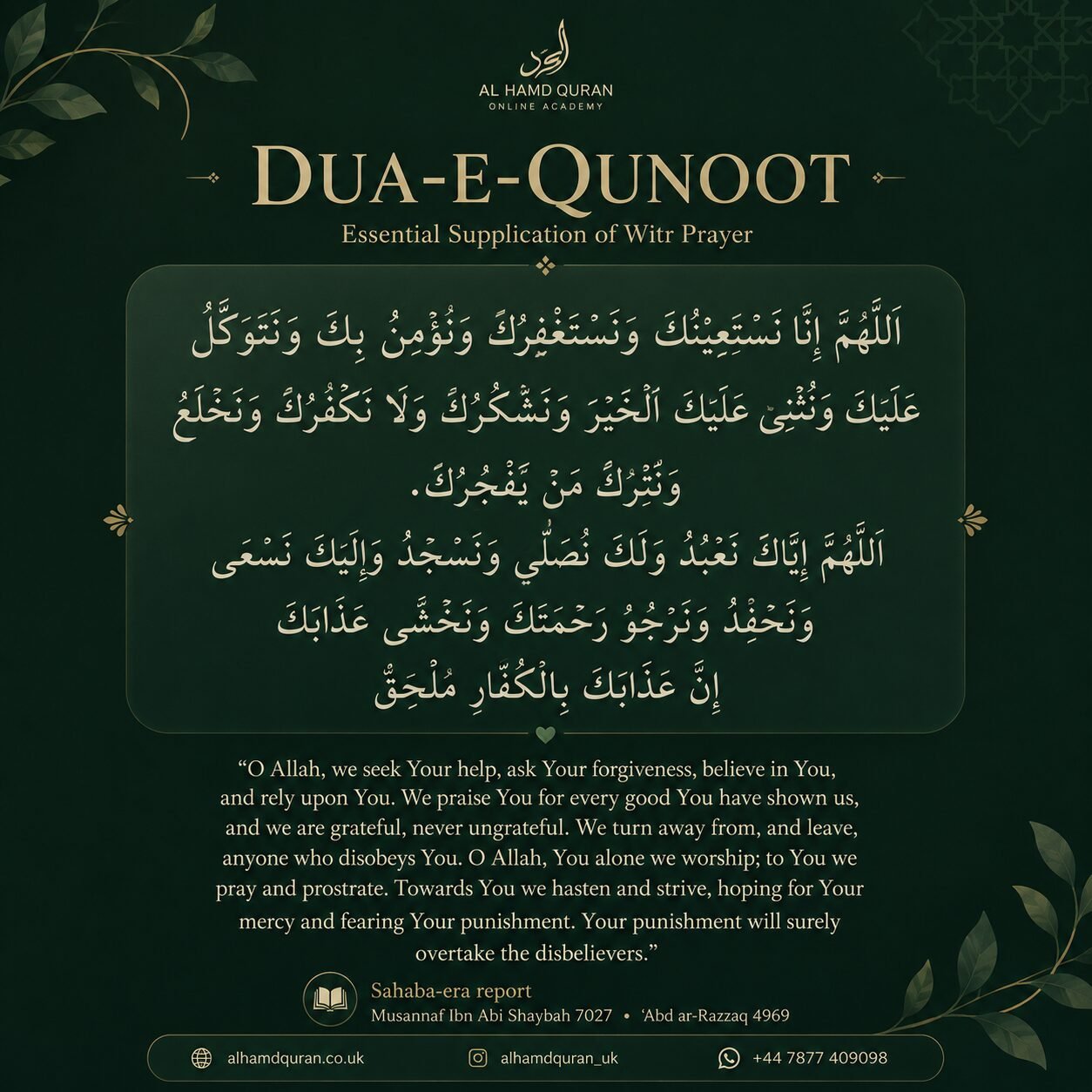
اَللَّهُمَّ اِنَّا نَسۡتَعِيۡنُكَ وَنَسۡتَغْفِرُكَ وَنُؤۡمِنُ بِكَ وَنَتَوَكَّلُ عَلَيۡكَ وَنُثۡنِىۡ عَلَيۡكَ ٱلۡخَيۡرَ وَنَشۡكُرُكَ وَلَا نَكۡفُرُكَ وَنَخۡلَعُ وَنَتۡرُكُ مَنۡ يَّفۡجُرُكَ ۔ اَللَّهُمَّ اِيَّاكَ نَعۡبُدُ وَلَكَ نُصَلِّئ وَنَسۡجُدُ وَاِلَيۡكَ نَسۡعٰى وَنَحۡفِدُ وَنَرۡجُوۡا رَحۡمَتَكَ وَنَخۡشٰى عَذَابَكَ اِنَّ عَذَابَكَ بِالۡكُفَّارِ مُلۡحِقٌ
Source: As-Sunan al-Kubra lil-Bayhaqi 2/201

Dua e Qunoot Transliteration

If you are still memorising the Arabic text, use this accurate transliteration to practice your recitation correctly.

Shafi Version — Transliteration
Allahumma ihdini feeman hadayt, wa a'fini fiman afait, wa tawallani fiman tawallait, wa barik li fima atait, wa qini sharra ma qadait, fa innaka taqdi wa la yuqda alaik, wa innahu la yadhillu man walait, wa la ya'izzu man 'adait, tabarakta Rabbana wa ta'alait.
Hanafi Version — Transliteration
Allahumma inna nasta-eenoka wa nastaghfiruka wa nu'minu bika wa natawakkalu alaika wa nusni alaikal khair, wa nashkuruka wala nakfuruka wa nakhla-oo wa natruku mai yafjuruka. Allahumma iyyaka na'budu wa laka nusalli wa nasjud wa ilaika nas'aa wa nahfidu wa narju rahmataka wa nakhsha azaabaka inna azaabaka bil kuffari mulhiq.

Tip: When learning the transliteration, read it slowly alongside the Arabic. Focus on the meaning of each phrase — this helps the words settle into your memory far more effectively than rote repetition alone.

Dua e Qunoot English Translation

Understanding the meaning of Dua e Qunoot transforms it from a memorised phrase into a heartfelt conversation with Allah. Read the English translation carefully.

Shafi Version — English Translation

"O Allah, guide me among those You have guided. Pardon me among those You have pardoned. Befriend me among those You have befriended. Bless me in what You have granted. And save me from the evil that You decreed. Indeed, You decree and none can pass decree upon You. Indeed, he is not humiliated whom You have befriended. And he is not honoured whom You have taken as Your enemy. Blessed are You, our Lord, and Exalted."

At-Tirmidhi 3:464 | Abu Dawud 8:1425
Hanafi Version — English Translation

"O Allah, we implore You for help and beg Your forgiveness, and we believe in You and rely on You, and we praise You in the best way, and we are thankful to You and are not ungrateful to You, and we forsake and turn away from those who disobey You. O Allah, You alone we worship and for You we pray and prostrate, and we hasten toward You and serve You, and we hope for Your mercy and fear Your punishment. Indeed, Your punishment will surely befall the disbelievers."

As-Sunan al-Kubra lil-Bayhaqi 2/201

Dua e Qunoot with Urdu Translation

For Urdu-speaking Muslims, here is the meaning of both versions in clear Urdu.

Shafi Version — Urdu Translation
اے اللہ! مجھے ہدایت دے ان لوگوں میں جنہیں تو نے ہدایت دی ہے۔ مجھے عافیت دے ان لوگوں میں جنہیں تو نے عافیت دی ہے۔ میری کارسازی فرما ان لوگوں میں جن کی تو نے کارسازی فرمائی ہے۔ جو کچھ تو نے مجھے عطا کیا ہے اس میں برکت دے۔ اور مجھے اس برے انجام سے بچا جو تو نے مقدر کیا ہے۔ بے شک تو ہی فیصلہ کرتا ہے اور تجھ پر کوئی فیصلہ نہیں کیا جا سکتا۔ جسے تو دوست رکھے وہ ذلیل نہیں ہوتا اور جسے تو دشمن رکھے وہ عزت نہیں پا سکتا۔ اے ہمارے رب! تو بابرکت اور بلند مرتبہ ہے۔

Note for Urdu-speaking readers: The Urdu translation above is a faithful rendering of the meaning. When reciting in Witr, always recite the original Arabic text — reciting a translation does not replace the Arabic.

Dua e Qunoot Meaning — Word by Word

Each phrase in the Shafi version of Dua e Qunoot carries a profound meaning. Here is a breakdown of what you are saying when you recite it.

Allahumma ihdini feeman hadayt

O Allah, guide me along with those whom You have guided. A request to be counted among the rightly guided — the prophets, the truthful, and the righteous.

Wa a'fini fiman afait

Grant me health and wellbeing among those You have given wellness to. This covers physical health, spiritual soundness, and protection from afflictions.

Wa barik li fima atait

Bless me in what You have given me. A request for barakah — divine blessing — in wealth, time, family, and every gift from Allah.

Wa qini sharra ma qadait

Protect me from the evil of what You have decreed. Seeking refuge in Allah from any hardship that is decreed — the ultimate trust in divine wisdom.

Innaka taqdi wa la yuqda alaik

You alone decree and no one decrees over You. A declaration of Allah's absolute sovereignty and authority over all creation.

Tabarakta Rabbana wa ta'alait

Blessed are You, our Lord, and Most High. A closing glorification of Allah — acknowledging His perfection and exaltation above all things.

Benefits of Dua e Qunoot

Reciting Dua e Qunoot regularly carries both spiritual and practical benefits for the believer. Here are the most significant ones.

Spiritual Connection with Allah

Standing in the quiet of the night after Isha and raising your hands to recite Dua e Qunoot is one of the most intimate moments of worship in Islamic practice. The Prophet ﷺ taught this dua as a gift to his grandson, and it has been passed down through generations as a means of drawing close to Allah.

Seeks Guidance on the Right Path

The dua specifically asks Allah to include us among the guided. This is a powerful acknowledgment that true guidance only comes from Allah — not from personal judgment, social pressure, or worldly reasoning.

Asks for Protection from Evil Decree

One of the most remarkable aspects of this dua is the request to be protected from the evil in what Allah has decreed. This teaches the believer to trust Allah's plan while also actively seeking His protection — a beautiful balance of tawakkul and du'a.

Builds Gratitude

The phrase asking for blessings in what Allah has given trains the heart to focus on gratitude. Rather than asking for more, it asks for barakah in what is already there — a mindset that Islam teaches as the foundation of contentment.

Imam an-Nawawi stated that the Witr prayer with Dua e Qunoot is among the most beloved night prayers in the Shafi school, and that its recitation with full presence of heart yields immense spiritual benefit.

Acknowledges Allah's Absolute Authority

The declaration that Allah decrees and none decrees over Him is a creedal statement embedded within a dua. Reciting it nightly strengthens aqeedah — the Muslim's theological foundation — without even realising it.

When to Read Dua e Qunoot

Dua e Qunoot is recited in the final rakah of the Witr prayer, which is performed after the obligatory Isha prayer each night. In the Hanafi school, it is recited before going into ruku (bowing). In the Shafi and other schools, it is recited after rising from ruku in the third rakah.

The Witr prayer itself can be prayed at any time between Isha and Fajr. Many Muslims pray it immediately after Isha, while others prefer to pray it in the last third of the night before Fajr — following the practice of the Prophet ﷺ who praised those who delay Witr.

Is There a Qunoot in Other Prayers?

Yes — there is a concept called Qunoot an-Nazilah, which is a special supplication made during times of calamity or hardship. It can be recited in the Fajr prayer or any of the five daily prayers. This is separate from the regular Dua e Qunoot of Witr.

Hanafi position: Dua e Qunoot in Witr is wajib (obligatory). Forgetting it requires a sajdah al-sahw at the end of the prayer.

Shafi/Maliki/Hanbali position: Dua e Qunoot in Witr is sunnah. Leaving it does not invalidate the prayer.

Dua e Qunoot in Witr Prayer

The Witr prayer is a highly recommended sunnah prayer and one of the most beloved forms of night worship in Islam. It is prayed in odd numbers — 1, 3, 5, 7, or 9 rakahs — and always ends with a single final rakah.

Dua e Qunoot is recited in that final rakah. Here is how it fits within the structure of the Witr prayer.

The Prophet Muhammad ﷺ said: "The Witr prayer is a right upon every Muslim. Whoever wishes may pray five rakahs, or three, or one." (Abu Dawud)

Position in the Hanafi Madhab

In the Hanafi school, the three-rakah Witr is prayed like Maghrib with a sitting after the second rakah. In the third rakah, after reciting Surah Al-Fatiha and another surah, the worshipper says the takbeer, raises their hands, and recites Dua e Qunoot before going into ruku.

Position in the Shafi Madhab

In the Shafi school, the Witr is typically prayed as separate rakahs with a salam after every two. The final single rakah includes Dua e Qunoot, which is recited after rising from ruku — in the standing position — before going into sajdah.

Step-by-Step Method of Reading Dua e Qunoot

Follow these steps carefully to perform your Witr prayer with Dua e Qunoot correctly according to the Hanafi method.

  1. Make the Intention (Niyyah)

    Intend in your heart to pray Witr prayer of three rakahs for the sake of Allah. Intention does not need to be spoken aloud.

  2. Pray the First Two Rakahs

    Pray two rakahs as normal, reciting Surah Al-Fatiha and any other surah in each. Perform ruku, sujood, and sit in tashahhud after the second rakah.

  3. Stand for the Third Rakah

    Rise for the third rakah. Recite Surah Al-Fatiha and another surah as normal.

  4. Say the Takbeer for Qunoot (Hanafi)

    After completing your recitation, say "Allahu Akbar" and raise your hands to your earlobes as you would at the start of prayer. Then fold your hands and begin reciting Dua e Qunoot.

  5. Recite Dua e Qunoot

    Recite the full Dua e Qunoot quietly (in an audible whisper to yourself). Focus on the meaning of each phrase as you recite it.

  6. Proceed to Ruku

    After completing the dua, say "Allahu Akbar" and bow into ruku. Continue the rakah as normal — completing ruku, sujood, and the final tashahhud.

  7. Complete the Salah

    Recite the full tashahhud, durood ibrahim, and the closing dua. Then complete the prayer with the salam on both sides.

Common Mistakes While Reading Dua e Qunoot

These are the most frequently made mistakes, along with the correct approach for each.

Mistake Correct Practice
Reciting too quickly without understanding the meaning Recite at a measured pace, focusing on the meaning of each phrase
Raising hands like a dua (palms up) in Hanafi madhab In Hanafi, fold hands as normal — raising palms is for Shafi practice
Skipping Dua e Qunoot entirely and not performing sajdah al-sahw (Hanafi) Perform two sajdahs of forgetfulness if you accidentally omit the dua
Reciting the wrong version for your madhab Follow the version appropriate to your school of thought
Saying "Ameen" loudly at the end if praying behind an imam Follow the imam quietly; response etiquette depends on the madhab
Mixing Hanafi and Shafi positions (e.g., reciting after ruku in Hanafi) Be consistent with your madhab — recite before ruku in Hanafi, after in Shafi

Authentic References from Hadith and Scholars

At-Tirmidhi 3:464

Al-Hasan ibn Ali ibn Abi Talib (may Allah be pleased with them both) narrated: "The Messenger of Allah ﷺ taught me some words to say in the Witr prayer." And he mentioned these words — the text of the Shafi Dua e Qunoot. Imam at-Tirmidhi graded this hadith as hasan (good).

Abu Dawud 8:1425

The same narration is found in the Sunan of Abu Dawud with a similarly reliable chain. Scholars of hadith have considered this chain sound and acceptable for practice.

As-Sunan al-Kubra lil-Bayhaqi 2/201

Imam al-Bayhaqi narrated the Hanafi version of Dua e Qunoot through Umar ibn al-Khattab (may Allah be pleased with him). This is the basis for the Hanafi practice of reciting the longer version in Witr.

All four major schools of Islamic jurisprudence — Hanafi, Maliki, Shafi, and Hanbali — recognise the legitimacy of Dua e Qunoot in Witr. The differences between them are matters of detail, not fundamental disagreement.

Everything You Need to Know About Dua e Qunoot

History

The Dua e Qunoot was taught by the Prophet Muhammad ﷺ to his grandson Al-Hasan ibn Ali when the boy was young. This narration, found in At-Tirmidhi and Abu Dawud, shows the Prophet's care in passing down personal acts of worship to the next generation. The Hanafi version traces back to the Caliph Umar ibn al-Khattab, who led the community in prayer with these words.

Purpose

The Witr prayer, in which Dua e Qunoot is recited, serves as a seal on the night's worship. It is the last prayer before sleep and its dua is a final conversation with Allah — a moment of complete vulnerability and trust. The purpose of the qunoot is not ritual but relational: a human soul asking its Creator for what it cannot secure on its own.

Spiritual Significance

In Islamic spirituality, the night prayer holds a special station. Allah says in the Quran: "Indeed, the hours of the night are more impactful and more conducive to alignment of hearts" (Al-Muzzammil 73:6). Standing in Witr and reciting this dua places the believer in that sacred night-time space of closeness to Allah.

Practical Application

For everyday Muslims, the most practical benefit of Dua e Qunoot is that it gives a structure to end the day with. Whatever has happened — good or difficult — this dua puts it all in perspective. You are reminding yourself that Allah guides, Allah protects, Allah blesses, and Allah decrees. This is the foundation of a Muslim's peace of mind.

Frequently Asked Questions About Dua e Qunoot

Dua e Qunoot is a special supplication recited during the Witr prayer after Isha salah. The word Qunoot means devout obedience and submission. It is a dua in which a Muslim asks Allah for guidance, pardon, protection from evil, and blessings in what has been given. It was taught by the Prophet ﷺ to his grandson Al-Hasan ibn Ali.
It is recited in the final rakah of the Witr prayer. In the Hanafi school, it comes before ruku. In the Shafi school, it comes after rising from ruku. The Witr itself is prayed after Isha and before Fajr.
According to the Hanafi madhab, it is wajib (obligatory) in Witr prayer. Forgetting it requires a sajdah al-sahw. According to the Shafi and most other schools, it is sunnah — highly recommended but not obligatory.
If you are Hanafi and forget to recite it, perform sajdah al-sahw — two extra sajdahs before the final salam. Your prayer is still valid. If you follow a madhab where it is sunnah, you may simply continue without any compensatory action.
Yes, scholars have permitted other supplications if you have not memorised Dua e Qunoot. Some allow reciting Surah Al-Ikhlas three times as a substitute. However, it is strongly recommended to memorise the authentic Dua e Qunoot as soon as possible.
The Arabic word Qunoot has several related meanings: devout obedience, standing in prayer, humility and submission to Allah, and continuous worship. When used in the context of salah, it refers to the act of standing and supplicating with complete devotion.
Yes. The Shafi version is shorter, beginning with "Allahumma ihdini feeman hadayt", and is narrated through Al-Hasan ibn Ali in At-Tirmidhi. The Hanafi version is longer, beginning with "Allahumma inna nasta-eenoka", narrated through Umar ibn al-Khattab in Bayhaqi. Both are authentic.
Witr can be prayed as 1, 3, 5, 7, or 9 rakahs. The most common practice is 3 rakahs. The Witr must always end with an odd number. Dua e Qunoot is recited in the final single rakah.
Yes, absolutely. Dua e Qunoot is for all Muslims — men, women, young, and old. Women pray Witr just as men do. The method and dua are the same.
When praying alone, you may recite it at a low audible level — enough to hear yourself. When praying in congregation, the imam may recite it aloud and the followers say "Ameen". In Hanafi practice, it is typically recited quietly even in congregation.
Qunoot al-Nazilah is a special supplication made during times of hardship, calamity, or crisis affecting the Muslim community. Unlike the regular Dua e Qunoot of Witr, it is made in any of the five daily prayers — especially Fajr — and its content is specific to the affliction being faced.
Yes, it should be memorised because you are reciting it during salah, and reading from a phone or paper during salah is disliked by most scholars. Until it is memorised, some scholars allow simple substitute supplications. Make memorisation a priority — it is not a long dua.
In the Shafi madhab, the hands are raised with palms facing upward during the recitation. In the Hanafi madhab, after saying the takbeer, the hands are folded as they are in regular standing — not raised with palms up.
According to the Hanafi school, Witr prayer is wajib — a strong obligation. According to the Shafi, Maliki, and Hanbali schools, it is a highly recommended sunnah. The Prophet ﷺ never abandoned his Witr prayer even while travelling.
Scholars differ on this. Some permit adding personal supplications in Arabic after the narrated text. The safest and most recommended approach is to recite the authentic Dua e Qunoot as taught by the Prophet ﷺ, and make personal du'as after the salam.
Witr can be prayed any time between after Isha prayer and before the Fajr prayer begins. The Prophet ﷺ prayed it at different times and said whoever fears they will not wake before Fajr should pray it before sleeping.
Make the effort to learn and practice. Allah is All-Knowing and sees your sincere intention. The Prophet ﷺ said that the one who recites the Quran while struggling with it receives a double reward. Keep practicing with the transliteration and seek a teacher if possible.
No specific dua is required before Dua e Qunoot. You simply say the takbeer (Allahu Akbar) and then begin the recitation. In the Shafi school, after rising from ruku you go directly into the dua without additional words beforehand.
According to the Shafi and Maliki schools, Dua e Qunoot is also recited in the second rakah of Fajr prayer — after rising from ruku. This is not practiced in the Hanafi school, where the Dua e Qunoot is specific to Witr.
Most people can memorise the shorter Shafi version within one to two weeks of daily practice — about ten to fifteen minutes per day. The Hanafi version is longer but can be learned within three to four weeks with consistent effort. Reciting it in every Witr prayer dramatically speeds up memorisation.

Expert Summary

ع

Editorial Review

AlhamdQuranAcademy — Islamic Content Team

Dua e Qunoot is one of the most beautiful expressions of a Muslim's reliance on Allah. It is not merely a ritual recitation — it is a nightly covenant. Every phrase asks Allah for something that only Allah can give: true guidance, real wellness, genuine barakah, and protection from hidden harm. The hadith evidence for it is solid, it is practiced by Muslims across all four major schools of jurisprudence, and its meaning is deep enough to reflect on for a lifetime. Whether you are learning it for the first time or have been reciting it for years, take a moment tonight in your Witr to actually listen to what you are saying.

Key Takeaways

  • Dua e Qunoot is a special supplication recited in the Witr prayer, performed after Isha each night.
  • There are two main authentic versions — the shorter Shafi version and the longer Hanafi version — both narrated in reliable hadith.
  • The word Qunoot means devout obedience, humility, and complete submission to Allah.
  • In the Hanafi school, reciting it is wajib (obligatory); in most other schools it is a strong sunnah.
  • In the Hanafi madhab it is recited before ruku; in the Shafi madhab after rising from ruku.
  • Its meaning includes asking for guidance, health, blessings, and protection from evil decree.
  • Forgetting it in the Hanafi school requires a sajdah al-sahw at the end of the prayer.
  • All four major schools of Islamic jurisprudence recognise its validity and its importance.
  • The Prophet ﷺ taught this dua personally to his grandson Al-Hasan ibn Ali — a sign of its special status.
  • It should be memorised in Arabic and recited with awareness of its meaning for maximum spiritual benefit.
Share the Post:

Related Posts

Where Faith and Knowledge Grow.

Links

Newsletter

Connect With Us