

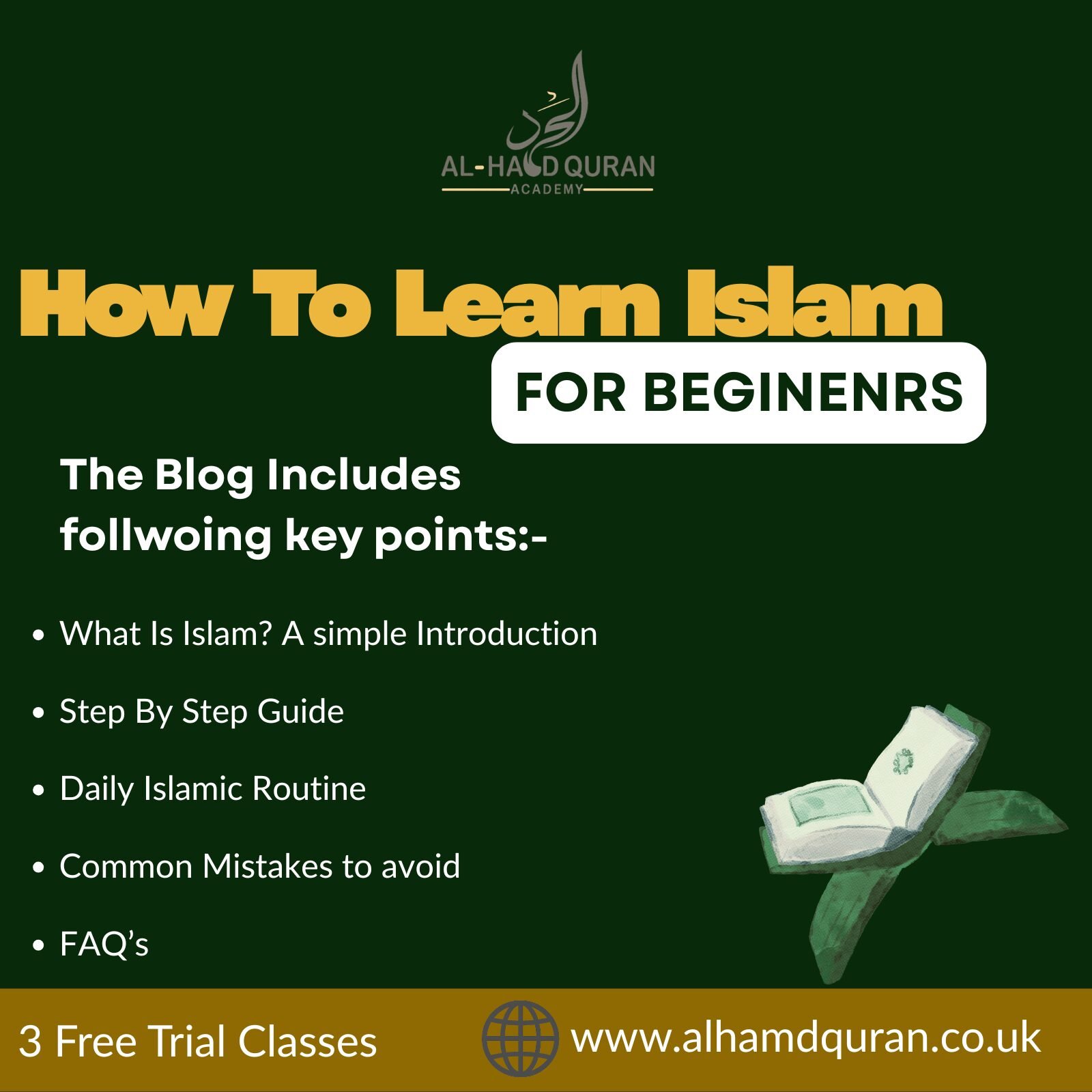
How to Learn Islam Step by Step
for Beginners
A simple, clear roadmap to start your Islamic journey — from the very first step to a confident daily practice.
Feeling overwhelmed about where to begin? You are not alone. Thousands of new Muslims — and even born Muslims who never had proper guidance — ask the same question every day: "How do I actually learn Islam step by step?"
There is so much information online that it can feel confusing and scattered. Some resources are too advanced. Others are too vague. What you need is a simple, clear roadmap — one that starts from zero and builds a solid foundation, one step at a time.
That is exactly what this guide is for. By the end, you will know precisely what to learn, in what order, and how to build a real daily Islamic routine that sticks.
Do not try to learn everything at once. Islam is a lifelong journey. Focus on one step at a time, and you will be amazed at how much progress you make in just a few months.
What Is Islam? A Simple Introduction
Islam is the religion of over 1.8 billion people worldwide. The word "Islam" means peace and submission — specifically, submitting one's will to Allah (God). It is a complete way of life that guides everything from prayer and worship to how we treat others, manage our time, and think about the world.
Islam is built on five foundational acts of worship, known as the Five Pillars of Islam. These pillars are the backbone of every Muslim's life.
Declaration of Faith
Daily Prayers
Annual Charity
Ramadan Fasting
Pilgrimage to Mecca
Understanding these pillars is your very first foundation. Everything else you learn will connect back to them.
Step-by-Step Guide to Learning Islam for Beginners
Here is a practical, proven sequence that beginners can follow to learn Islam basics in the right order.
Learn the Core Beliefs (Aqeedah)
Before anything else, understand what you believe. Aqeedah means Islamic belief. As a beginner, you need to know: Who is Allah? Who is Prophet Muhammad ﷺ? What is the purpose of life? Start with simple books or short video lessons on the six articles of faith: belief in Allah, His angels, His books, His prophets, the Day of Judgment, and divine decree (Qadar).
Learn Wudu (Purification)
Before you can pray, you need to be in a state of ritual purity. Wudu is the Islamic method of washing specific parts of the body — face, hands, head, and feet — in a specific order. It takes only a few minutes. Learn the steps, practice them until they feel natural, and understand when Wudu is required and when it is broken.
Start Salah (Daily Prayer) Step by Step
Salah is the most important act of worship in Islam. Muslims pray five times a day: Fajr (dawn), Dhuhr (midday), Asr (afternoon), Maghrib (sunset), and Isha (night). Begin by learning the movements and the key Arabic phrases. You do not need to memorize everything at once — start with Fajr (2 units) and gradually add each prayer. Having a teacher guide your pronunciation and posture makes this dramatically easier.
Begin Quran Learning from Qaida
The Quran is the holy book of Islam, revealed in Arabic. As a beginner — even if Arabic is completely foreign to you — start with the Noorani Qaida, a beginner's Arabic alphabet book specifically designed for Quran learners. It teaches you letters, vowels, and basic rules of recitation in a simple, step-by-step way. Most students can begin reading the Quran within 2–3 months of starting Qaida.
Build a Simple Daily Islamic Routine
Consistency beats intensity. Once you have the basics, build a gentle daily routine around them. This could be as simple as: praying Fajr on time, reading a few Quran verses each morning, and learning one new Islamic concept per week. Small habits, done daily, create remarkable transformation over months.
A Simple Daily Islamic Routine for Beginners
One of the best ways to start practicing Islam is to attach Islamic habits to your existing daily schedule. Here is a beginner-friendly routine you can start today:
- 🌅 Before Sunrise Wake up for Fajr prayer. Make Wudu, pray 2 sunnah + 2 fardh units. Read 5–10 verses of Quran with translation.
- 🕛 Midday Perform Dhuhr prayer. Say Bismillah before meals. Practice one short dua (supplication) from a beginner dua list.
- 🌤 Afternoon Pray Asr on time. Take 5 minutes to listen to or read a short hadith (saying of the Prophet ﷺ).
- 🌆 Sunset Pray Maghrib. Recite the evening Adhkar (remembrance phrases — takes only 3–5 minutes).
- 🌙 Night Pray Isha. Spend 10–15 minutes on your online Islamic lesson or Quran class. Read Ayat al-Kursi before sleeping.
Start with just Fajr and Maghrib if praying all five feels overwhelming. The Prophet ﷺ said: "The most beloved deeds to Allah are the most consistent ones, even if they are small." Build up gradually.
Common Mistakes Beginners Make (And How to Avoid Them)
Many beginners struggle not because Islam is difficult, but because of a few very common mistakes. Being aware of them puts you miles ahead.
-
❌Trying to learn everything at once. It is tempting to study Aqeedah, Fiqh, Quran, Arabic, and Seerah all at the same time. This leads to burnout within weeks. Focus on one area at a time with a clear curriculum.
-
❌Being inconsistent. Studying for 3 hours on one day and nothing for the next 10 days is far less effective than 20 minutes every single day. Consistency is the key to real progress.
-
❌Learning without a qualified teacher. Random YouTube videos and unverified websites can lead you to incorrect information — especially with Quran recitation and prayer rules. A qualified teacher ensures you are learning correctly from the start.
-
❌Comparing your journey to others. Everyone starts differently. Some people grew up with Islam; others are discovering it for the first time. Your pace is your pace — and every sincere step counts with Allah.
Why Structured Islamic Learning Makes All the Difference
Would you learn to drive a car by watching random clips online? Probably not — you would want a licensed instructor. Learning Islam is similar. A structured course with a qualified teacher gives you:
- Correct Quran recitation — Tajweed rules cannot be learned from text alone; a teacher's voice corrects you in real time.
- Accountability — Regular sessions keep you consistent when motivation dips.
- Personalised pace — A good teacher adapts to where you are, not a fixed group speed.
- Accurate answers — Questions about prayer, purity, halal and haram need reliable Islamic guidance, not a Google search.
At Al-Hamd Online Quran Teaching Academy, our qualified teachers have helped hundreds of beginners across the UK, USA, Canada, and beyond build a confident Islamic practice — all from home, at flexible times that suit their lifestyle.
Start Your Journey to Learn Islam Today
Join our expert teachers and learn Islam step by step from the comfort of your home.
- One-on-one classes
- Flexible timings (UK, USA, worldwide)
- Kids & adults friendly
- 3 FREE trial classes
Frequently Asked Questions
Here are the most common questions from beginners who want to learn Islam basics and start their Islamic journey.
Your First Step Starts Today
The journey of a thousand miles begins with a single step — and in Islam, that step is your intention (niyyah). The moment you decide in your heart to seek knowledge and draw closer to Allah, your journey has already begun.
You do not need to be perfect. You do not need to know everything. You simply need to start — with sincerity, consistency, and the right guidance by your side.
Islam is not complicated at its core. It is a religion of mercy, clarity, and purpose. With the right roadmap and a qualified teacher, you will be amazed at how naturally it comes together.
The Prophet Muhammad ﷺ said: "Seeking knowledge is an obligation upon every Muslim." You are fulfilling that obligation right now. Take the next step with confidence.
If you are ready to take action, Al-Hamd Online Quran Teaching Academy is here to guide you every step of the way — with experienced teachers, flexible timings, and a warm, beginner-friendly environment. Your first 3 classes are completely free. There is nothing to lose, and everything to gain.