
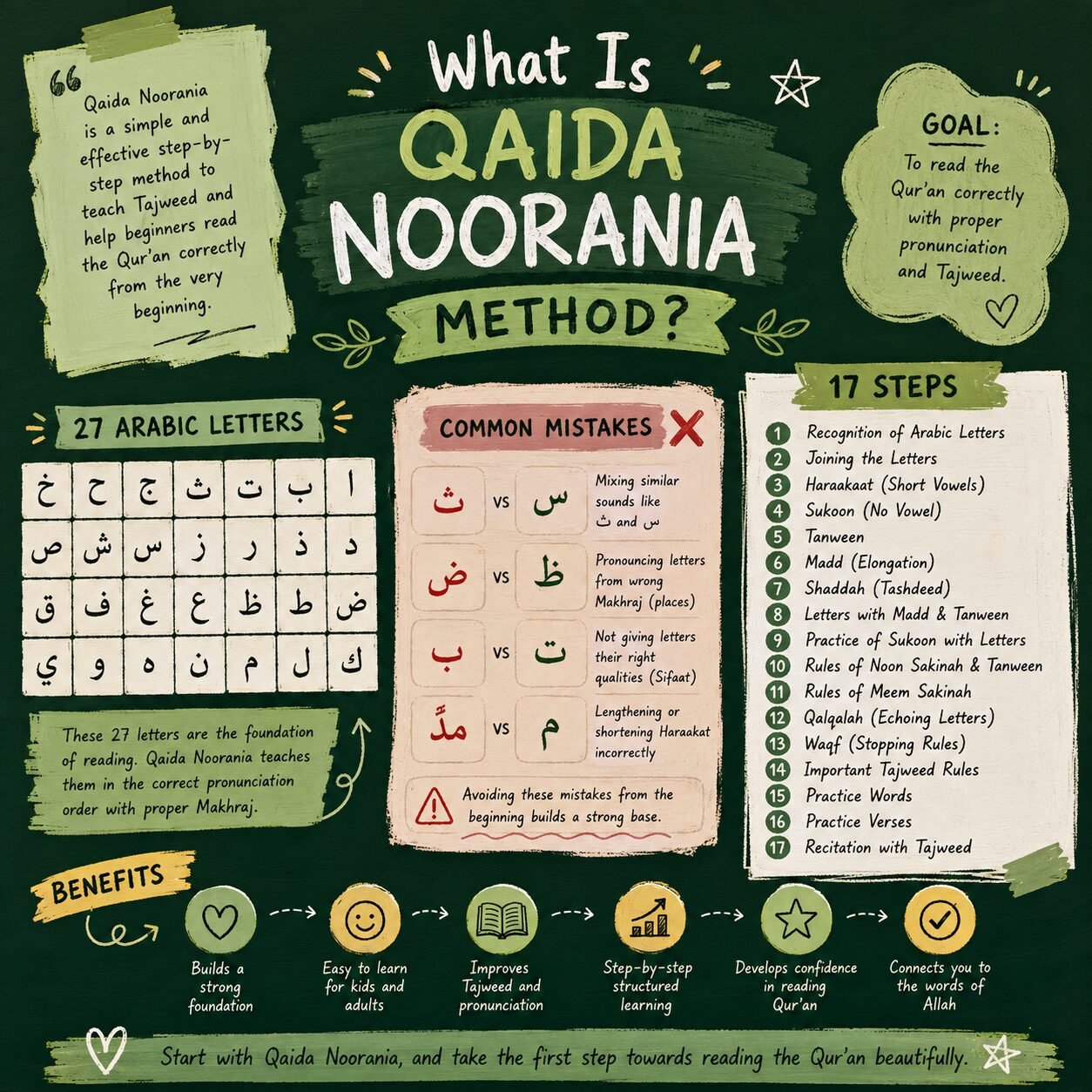
What is the Qaida Noorania Method?
The scientifically structured pathway that transforms non-Arabic speakers into confident, beautiful Quran readers — one root at a time.
A structured Tajweed system developed by Sheikh Noor Muhammad Haqqani for non-Arabic learners.
UK Muslims struggle with Arabic phonetics due to 28 sounds absent from English entirely.
17 sequential steps build like an archway — each mastered lesson lights the path forward.
Confident, accurate Quran recitation with proper Tajweed — achieved from scratch, at any age.
What is the Qaida Noorania Method?
At its core, the Qaida Noorania Method is a structured, progressive system for teaching the Arabic alphabet and the rules of Tajweed — the precise science of correct Quranic recitation — to learners who have no prior knowledge of the Arabic language. The word Qaida (قاعدة) means "foundation" or "base rule," and Noorania refers to its luminous, light-bringing nature. Together, they describe exactly what this method does: it lays a radiant foundation.
The Qaida Noorania was developed by Sheikh Noor Muhammad Haqqani (رحمه الله), a Pakistani Islamic scholar who recognised in the mid-20th century that millions of non-Arab Muslims worldwide — particularly in South Asia and, increasingly, in the diaspora communities of the United Kingdom — were reciting the Quran without truly understanding how to produce Arabic sounds correctly. His solution was methodical, brilliant, and lasting: a carefully sequenced primer that takes a complete beginner from zero knowledge of Arabic script to fluent, rule-governed Quranic recitation in a systematised, reproducible programme.
Unlike informal or traditional methods that often rely on rote memorisation without explanation, the Qaida Noorania is built on a deep understanding of Makharij al-Huroof — the articulation points of Arabic letters — and the Sifaat al-Huroof — the acoustic characteristics of each sound. Every step in the method is positioned to build directly upon the last, much like roots deepening before a tree is permitted to grow upward.
"A building is only as strong as its foundation. The Qaida Noorania is not a shortcut to Quran reading — it is the correct beginning." — Traditional principle of Islamic pedagogical methodology
For the growing community of British-born Muslims and reverts across the United Kingdom — from London to Manchester, Birmingham to Edinburgh — the Qaida Noorania has become the gold standard starting point for any serious Online Quran Academy programme. It is the method that answers the question every non-Arabic speaker quietly carries: "Where do I even begin?"
Every Arabic letter emerges from a precise point in the vocal tract. These articulation points are the roots — before any leaf can grow, the roots must go deep.
The Challenge of Arabic Pronunciation for Non-Arabic Speakers in the UK
The United Kingdom is home to approximately 3.9 million Muslims, the vast majority of whom speak English as their primary — and often sole — language. Whether British-born, second or third generation South Asian, or a revert to Islam from any background, these communities share a singular, silent challenge: the Arabic language contains sounds that simply do not exist in English.
28 Unfamiliar Sounds
Arabic contains 28 consonant sounds. At least 12 have no English equivalent whatsoever — including the emphatic letters (Ḥuroof Mufakhkhama) and the guttural letters of the throat.
Tajweed Rules Are Non-Negotiable
Unlike learning conversational Arabic, reciting the Quran requires strict adherence to Tajweed rules. A single mispronounced letter can alter the meaning of a sacred verse entirely.
No Childhood Immersion
Arabic speakers absorb phonetics naturally from birth. UK non-Arabic learners must consciously retrain their vocal tracts as adults — a process that requires structured, expert guidance.
Limited Qualified Access
Outside major cities, qualified Tajweed tutors are scarce. Online Quran academies in the UK have become the primary solution — but only those using proven methodologies like Qaida Noorania truly deliver.
"Have you ever read through an entire Surah during prayer, then paused afterwards and wondered: 'Am I pronouncing this correctly?' That quiet uncertainty is the very thing the Qaida Noorania was designed to permanently resolve."
The consequences of mispronunciation in Quranic recitation are serious in Islamic scholarship. The letter Qaf (ق) and Kaf (ك), for instance, are often collapsed into a single "k" sound by non-native speakers — yet they are phonetically and spiritually distinct. The letter Ayn (ع) has no English equivalent and requires specific muscular control of the pharynx. The Qaida Noorania addresses each of these challenges systematically, patiently, and effectively.
How It Works: The 17 Progressive Steps
Visualise the entrance to a great mosque — a majestic archway being assembled block by glowing block. Each of the 17 Noorania lessons is one stone. When mastered, it illuminates. When all 17 are lit, the archway is complete — and the path into Quranic fluency lies open before you.
Tap any step to mark it as mastered ✦
Why the Qaida Noorania is So Effective
The effectiveness of the Qaida Noorania for non-Arabic speakers is not accidental — it is the result of a profound alignment between how human beings acquire phonological skills and how the method structures its content. Modern learning science calls this multimodal encoding: the more sensory channels engaged simultaneously, the deeper and more durable the learning.
The Cognitive Science
Research in phonological acquisition shows that adults learning new sound systems require simultaneous auditory input, visual letter recognition, and kinaesthetic (mouth movement) practice. The Qaida Noorania engages all three channels at every step — making it neurologically optimised for adult non-native learners.
The Islamic Wisdom
The Prophet Muhammad ﷺ said: "The best among you are those who learn the Quran and teach it." (Bukhari). The scholars understood that correct recitation requires a teacher, a method, and consistent practice — a triad that the Qaida Noorania enshrines in every single lesson.
Each letter has a unique articulation point. Navigate the alphabet and observe the pronunciation guidance.
Produced by bringing both lips together firmly. The air is held momentarily, then released as a bilabial stop.
Visual-Auditory Synchronisation
Each lesson pairs the written letter with its correct sound simultaneously — training the eyes and ears to work as one. This dual encoding is the reason students retain Noorania lessons far longer than rote methods.
Progressive Complexity
The method never introduces a new concept before the previous one is secure. Like an archway: no stone is placed until the one beneath it is load-bearing. There is no skipping, no rushing — only mastery.
Built-In Repetition Science
Spaced repetition is embedded structurally into the 17 steps. Letters introduced in Step 1 reappear — in new combinations — in Steps 5, 9, and 13. Each encounter deepens the neural pathway further.
"Can you name the five articulation zones of Arabic speech? If not, you haven't started at the root. The Qaida Noorania begins exactly there — and it takes you all the way to the crown."
The Importance of a Qualified Tutor
Why self-study with Qaida Noorania is not enough — and what to look for in a teacher
The Qaida Noorania is a powerful methodology — but it is not a self-guided manual. In Islamic scholarship, the oral tradition of Quran transmission is considered Tawatur — an unbroken chain of transmission from teacher to student, stretching back to the Prophet ﷺ himself. A book, an app, or a video cannot grant you that chain. A qualified teacher can.
-
Real-time pronunciation correction is irreplaceable. A qualified tutor can hear the precise moment your tongue placement is incorrect and correct it in that breath. No software can replicate this. The Makharij cannot be learned from a screen alone.
-
Ijazah-certified tutors carry the sacred chain. An Ijazah is an authorisation granted by a qualified scholar, confirming that the student has recited the Quran correctly with proper Tajweed. Our tutors at AlhamdQuran are Ijazah-certified — meaning your recitation is connected to the authentic tradition.
-
Personalised pacing prevents fossilisation of errors. Every learner develops unique pronunciation habits. Left uncorrected, these habits become fossilised — permanently embedded. A qualified tutor identifies and addresses these patterns before they set.
-
Motivation and accountability sustain the journey. Research consistently shows that learners with human mentors are 3–5× more likely to complete a programme than self-studiers. The tree grows stronger in a forest than in isolation.
How to Get the Most from the Qaida Noorania
- Commit to daily practice, not occasional study. Even 15 minutes of daily Qaida Noorania work produces more lasting results than two hours once a week. Roots grow through consistent watering.
- Record yourself regularly. The human ear is not reliable at detecting its own errors. Short recordings played back — ideally reviewed with your tutor — reveal pronunciation habits invisible in the moment.
- Never skip a step. The sequential architecture of the 17-step programme is non-negotiable. Each archway stone must be set before the next is placed. Patience at Step 3 prevents collapse at Step 14.
- Separate listening from recitation practice. Listen to expert recitation (Qaris) daily as supplementary input. This unconsciously trains your phonological expectations alongside the explicit tutor-led lessons.
- Begin with a qualified teacher, not an app. Use the method with a certified tutor, at least for the foundational steps. The Quran deserves — and requires — human transmission.
The Path Forward: Your Roots, Your Quran
The Qaida Noorania Method is not a quick fix. It is not a shortcut. It is a foundation — deep, wide, and enduring — upon which a lifetime of beautiful Quranic recitation can be built. For non-Arabic speakers in the United Kingdom and across the Muslim world, it represents the single most structurally sound entry point into the sacred science of Tajweed.
The tree that grows slowly, with deep roots, withstands every storm. The believer who learns the Quran correctly — letter by letter, rule by rule, with a qualified teacher by their side — carries something no digital distraction can erode: the Word of Allah, recited as it was intended to be heard.
Your journey begins with one step. Step One of Seventeen. One root, growing downward, before the tree reaches for the light.
Begin Your
Qaida Noorania
Journey Today
Join over 1,000 UK students who have transformed their Quran recitation with our expert, Ijazah-certified tutors — using the proven Qaida Noorania Method.
Claim Your 3 Free Trial Classes →
Available 7 days a week · Morning, afternoon & evening slots · Male & female tutors · All ages welcome