

How to Pray Salah:
A Complete Step-by-Step Guide
From purification to prostration — everything you need to establish your connection with Allah through the five daily prayers.
Learning how to pray Salah is one of the most profound steps a Muslim takes on their spiritual journey. Like roots reaching deep into fertile earth, Salah anchors the believer to Allah — five times a day, every day, across a lifetime.
Whether you are a new Muslim, a revert rediscovering your faith, or someone who simply wants a clearer understanding of the prayer they grew up performing, this comprehensive guide walks you through every detail — from the spiritual significance of Salah to the precise physical movements and Arabic recitations.
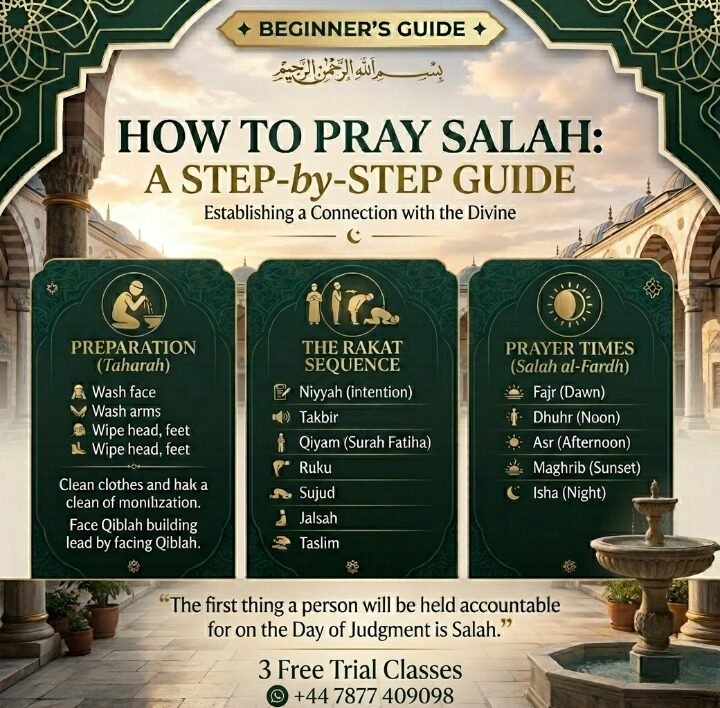
"The first matter that the slave will be brought to account for on the Day of Judgement is the prayer. If it is sound, then the rest of his deeds will be sound. And if it is corrupt, then the rest of his deeds will be corrupt."
— Prophet Muhammad ﷺ (At-Tabarani)
☀️ The Importance and Benefits of Salah
Salah — also written as Salat — is the second of the Five Pillars of Islam. It is not merely a ritual; it is a living conversation between the servant and the Creator. The Arabic root of the word Salah means "connection," and that is precisely what it is — a lifeline between the human soul and Allah.
The Quran commands prayer in dozens of verses, and the Prophet Muhammad ﷺ described it as the pillar of the religion. To perform Salah correctly and consistently is to stand firmly on the foundation of one's faith.
Spiritual and Practical Benefits
Peace of Heart
Regular Salah reduces anxiety and stress. The Quran says: "Verily, in the remembrance of Allah do hearts find rest." (13:28)
Spiritual Growth
Each prayer is an opportunity to grow closer to Allah, reflect on your intentions, and renew your commitment to a righteous life.
Protection from Evil
"Indeed, prayer prohibits immorality and wrongdoing." (Quran 29:45) Consistent prayer guards the believer's character.
Structure and Discipline
Five prayers space your day with mindfulness, creating a natural rhythm of devotion that shapes your priorities.
🌙 The Five Daily Prayer Times
Allah has prescribed five prayers at specific times throughout the day and night, so that no more than a few hours pass without the believer pausing to remember their Lord. Each prayer carries a unique atmosphere — from the quiet stillness of dawn to the deep calm of night.
Exact prayer times vary by location and season. Use a reliable Islamic prayer app or website to find precise timings for your city.
✨ Preparing for Salah
Before standing before Allah in prayer, certain conditions must be met. Think of this preparation as tending to a sacred space — clearing the ground so that something beautiful may grow.
1. Physical Cleanliness (Taharah)
Your body, clothing, and the place of prayer must be free from ritual impurity (najasah). If any impurity is present on your clothes, it must be cleaned before prayer.
2. Covering the Awrah
Men must cover from the navel to the knee at minimum. Women must cover the entire body except the face and hands during prayer.
3. Facing the Qiblah
All Muslims face the direction of the Ka'bah in Makkah (Mecca) during prayer. Use a compass or a prayer app to find the correct Qiblah direction from your location.
4. Entering the Prayer Time
Each of the five prayers has a specific window of time. Salah is only valid when its prescribed time has entered.
5. Making Niyyah (Intention)
Before beginning, make a sincere intention in your heart that you are performing this specific prayer for Allah alone. The intention does not need to be spoken aloud — it is an act of the heart.
💧 How to Perform Wudu (Ablution)
Wudu is ritual purification using water. It is obligatory before every prayer and is a beautiful act of cleansing both body and intention. The Prophet ﷺ said that when a Muslim washes each limb, their sins leave with the water.
Begin with Intention & Bismillah
Make the intention for Wudu in your heart and say "Bismillah" (In the Name of Allah) before starting.
Wash Both Hands
Wash both hands up to the wrists three times, ensuring water reaches between the fingers.
Rinse the Mouth
Take water into your mouth and rinse thoroughly three times.
Cleanse the Nostrils
Sniff water into your nostrils and blow it out three times using your left hand.
Wash the Face
Wash the entire face — from hairline to chin, and ear to ear — three times.
Wash Both Arms
Wash the right arm first, then the left, from the fingertips up to and including the elbows — three times each.
Wipe the Head (Masah)
Dampen your hands and wipe them over your head from forehead to the back of the neck, and return — once.
Wipe the Ears
With the same dampened hands, use your index fingers to wipe inside the ears and thumbs behind them — once.
Wash Both Feet
Wash the right foot first, then the left, up to and including the ankles, ensuring water reaches between the toes — three times each.
Wudu is invalidated by using the toilet, passing wind, deep sleep, bleeding, and certain other acts. If Wudu is broken, it must be renewed before the next prayer.
🕋 How to Pray Salah: Step-by-Step (One Rakat)
A Rakat is a single unit of prayer consisting of a fixed sequence of standing, recitation, bowing, and prostration. All five daily prayers are made up of a set number of Rakats. Here is a complete, detailed guide to performing one Rakat:
Takbirat al-Ihram — Opening Takbeer
Stand upright, facing the Qiblah. Raise both hands to your earlobes (men) or shoulders (women) and say:
Allahu Akbar
"Allah is the Greatest"
Lower your hands and place the right hand over the left on the chest. Your gaze should rest on the place of prostration. The prayer has now officially begun.
Qiyam — Standing & Recitation
While standing, recite the opening supplication (Dua al-Istiftah) silently, then seek refuge from Shaytan:
A'udhu billahi minash-shaytanir-rajim
"I seek refuge in Allah from the accursed Shaytan"
Then say Bismillah and recite Surah Al-Fatiha, followed by any short Surah or verses from the Quran. See the Recitations section below for the full text.
Ruku — Bowing
Say "Allahu Akbar" and bow from the waist, keeping your back straight and parallel to the ground. Place both hands firmly on your knees. In this position, recite three times:
Subhana Rabbiyal Adheem
"Glory be to my Lord, the Most Great"
I'tidal — Rising from Ruku
Rise back to a fully upright standing position, lifting your hands to your ears and saying:
Sami' Allahu liman hamidah
"Allah hears those who praise Him"
Once standing straight, say: Rabbana lakal hamd — "Our Lord, to You belongs all praise."
First Sujud — Prostration
Say "Allahu Akbar" and go down into prostration. Seven body parts must touch the ground: forehead and nose, both palms, both knees, and the toes of both feet. In this position, recite three times:
Subhana Rabbiyal A'la
"Glory be to my Lord, the Most High"
This is the closest a believer comes to Allah — make sincere du'a in your heart.
Jalsah — Sitting Between Two Prostrations
Rise from prostration saying "Allahu Akbar" and sit upright on your left foot, with your right foot upright. Place your hands on your knees and say:
Rabbighfir li
"My Lord, forgive me"
Second Sujud — Second Prostration
Say "Allahu Akbar" and perform the second prostration, exactly as the first. Recite Subhana Rabbiyal A'la three times.
This completes one full Rakat. Rise saying "Allahu Akbar" to begin the next Rakat, or proceed to Tashahhud if this is the final Rakat.
Tashahhud — Final Sitting (After Last Rakat)
After the final Rakat, sit in the Tashahhud position and recite:
At-tahiyyatu lillahi was-salawatu wat-tayyibat. As-salamu alayka ayyuhan-Nabiyyu wa rahmatullahi wa barakatuh. As-salamu alayna wa ala ibadillahis-salihin. Ashhadu alla ilaha illallahu wa ashhadu anna Muhammadan abduhu wa rasuluh.
Then recite Salawat (Durood Ibrahim) and end with the Tasleem.
Tasleem — Ending the Prayer
Turn your head to the right and say:
Assalamu Alaikum wa Rahmatullah
"Peace and mercy of Allah be upon you"
Then turn your head to the left and repeat. The prayer is now complete.
📿 Key Recitations and Their Meanings
Understanding what you recite deepens your connection during prayer. Here are the two most essential recitations performed in every Salah:
Surah Al-Ikhlas is a favourite short surah for Salah because the Prophet ﷺ said it is equivalent to one-third of the Quran in reward. Other short surahs such as Al-Falaq (113), An-Nas (114), Al-Kawthar (108), and Al-Asr (103) are also commonly used.
🔢 Rakat Count for Each Daily Prayer
Each daily prayer consists of Fardh (obligatory) Rakats and optional Sunnah Rakats. The table below shows the complete breakdown:
| Prayer | Sunnah (Before) | Fardh | Sunnah (After) | Witr/Nafl |
|---|---|---|---|---|
| Fajr (Dawn) | 2 | 2 | — | — |
| Dhuhr (Midday) | 4 | 4 | 2 | — |
| Asr (Afternoon) | 4 | 4 | — | — |
| Maghrib (Sunset) | — | 3 | 2 | — |
| Isha (Night) | 4 | 4 | 2 | 3 Witr |
Note: The Sunnah Rakats listed above are Sunnah Muakkadah (strongly recommended). The Fardh Rakats are obligatory for every adult Muslim.
🌱 Tips for Beginners
Starting to pray Salah can feel unfamiliar at first — the postures, the Arabic, the timing. But like any living thing that grows in the right conditions, your prayer will blossom with consistency and care. Here are some practical tips to help you:
Start with the Fardh Only
In the beginning, focus on the obligatory Rakats of each prayer. Add Sunnah prayers gradually as you grow more comfortable.
Learn Surah Al-Fatiha First
Memorise and understand Al-Fatiha before anything else — it is recited in every single Rakat and is the heart of the prayer.
Use a Prayer App
Apps like Muslim Pro or Athan can help you track prayer times, find the Qiblah, and even guide you through Wudu and Salah steps.
Understand What You Recite
Learning the meanings of your recitations transforms Salah from a routine into a heartfelt conversation with your Creator.
Be Consistent, Not Perfect
A small, consistent prayer offered sincerely is more beloved to Allah than a grand one offered occasionally. Begin — and keep going.
Seek a Teacher
Learning Salah with a qualified teacher ensures correct pronunciation, posture, and understanding — especially for Tajweed and Wudu.
🛑 Common Mistakes to Avoid in Salah
Many Muslims, especially beginners, unknowingly make errors in their prayer. Being aware of these will help you refine your Salah and ensure it is valid and accepted, insha'Allah.
Rushing Through the Prayer
Moving too quickly between positions without maintaining stillness (tuma'ninah) is one of the most common and serious errors. Each position should be held with calm, complete stillness.
Not Ensuring Wudu is Valid
Praying without valid Wudu — or with Wudu that has been nullified — renders the prayer invalid. Always renew Wudu after it is broken.
Incomplete Prostration (Sujud)
All seven body parts must fully touch the ground in Sujud: forehead, nose, both palms, both knees, and all toes. Lifting any of these invalidates that prostration.
Looking Around During Salah
The Prophet ﷺ warned against looking around in prayer, describing it as "snatching" that Shaytan performs. Keep your gaze fixed on the place of Sujud.
Incorrect Niyyah (Intention)
The intention must correspond to the specific prayer being performed (e.g., intending Fajr when performing Fajr). Vague or absent intention is problematic.
Not Facing the Correct Qiblah
Deliberately praying away from the Qiblah direction without valid reason invalidates the prayer. Use a reliable app or compass to verify the direction.
Learning how to pray Salah is a journey, not a destination. Every prayer you offer — however imperfect — is a step closer to Allah. Do not let the fear of imperfection keep you from beginning. Start where you are, with what you know, and grow from there.
The Prophet Muhammad ﷺ said: "The coolness of my eyes has been placed in prayer." May Allah make Salah the coolness of your eyes too — a sanctuary you return to five times each day, finding in it peace, purpose, and the nearness of your Lord.
If you are looking for qualified, patient teachers who can guide you through every step of Salah, Wudu, Quran recitation, and Islamic knowledge — a trusted Online Quran Academy can transform your learning journey from the comfort of your home, wherever you are in the world.
🌿 Ready to Deepen Your Connection?
Join our 3 FREE Trial Classes to enhance your understanding of Salah, Quran recitation, Wudu, and more — with qualified teachers who guide you at your own pace.
Have questions? Connect with us on WhatsApp: +44 7877 409098