

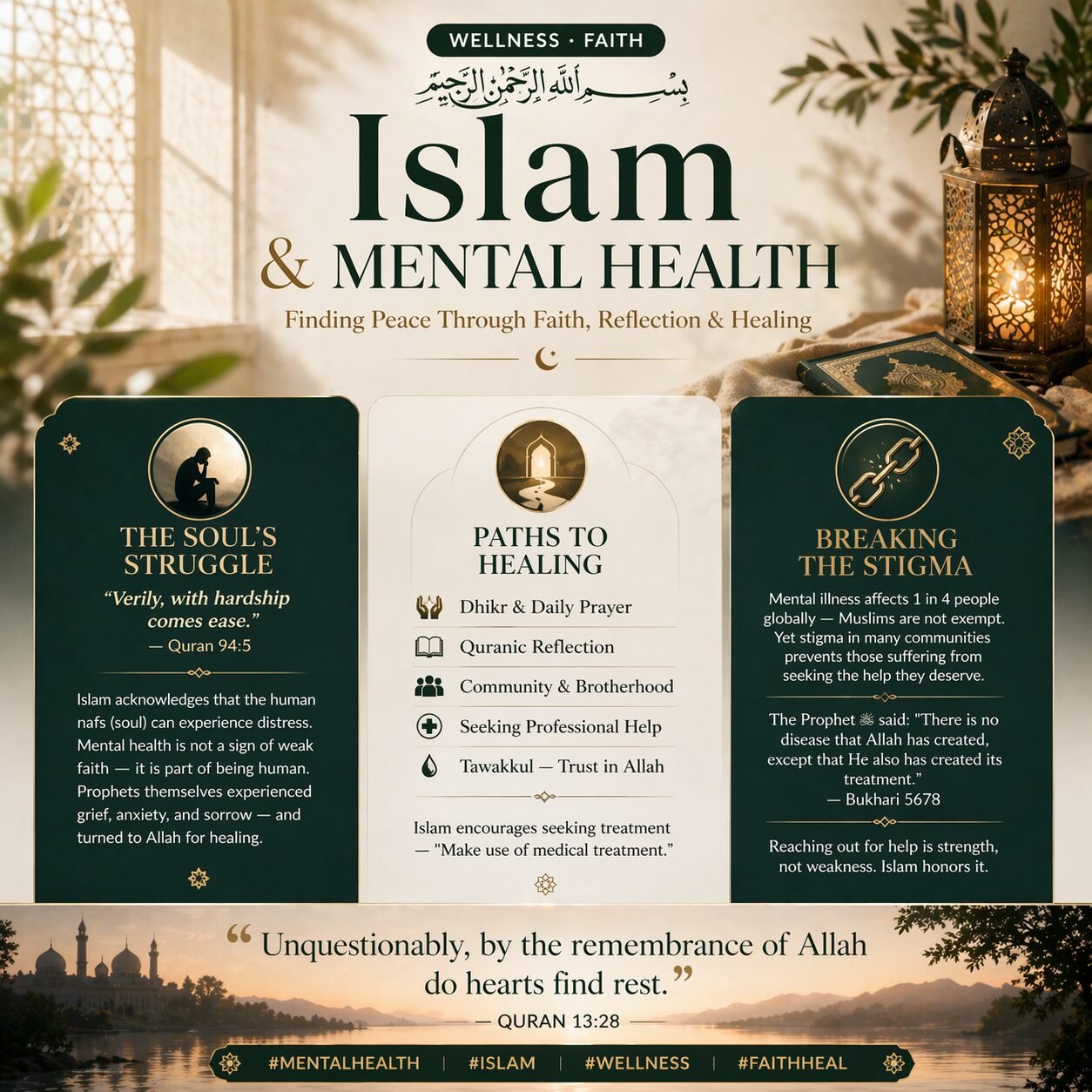
Islam and Mental Health:
Islamic Ways to Overcome Anxiety
It is 2am and your mind will not stop. Worry after worry, thought after thought — a cycle that feels impossible to break.
Sound familiar? You are far from alone. Across the world, millions of people silently battle anxiety every single day. It does not matter where you live or how successful you are. The restless mind does not discriminate.
What many people do not realise is that Islam and mental health have always been deeply connected. Long before therapy and mindfulness became popular, the Quran and the Prophet Muhammad (peace be upon him) were already offering guidance for the anxious, overwhelmed human heart — and that guidance is just as relevant today.
The Mental Health Crisis of Modern Life
We live in an age of extraordinary convenience — yet people have never felt more anxious, more burned out, or more disconnected from themselves.
Modern life comes with its own unique set of pressures:
- Non-stop social media and information overload
- Financial pressure and the fear of falling behind
- Loneliness despite being constantly "connected"
- Loss of purpose and spiritual emptiness
- The weight of global news — war, suffering, uncertainty
- Family expectations pulling in multiple directions
For Muslims, there is an added layer. Many feel pressure to be the "perfect believer" while also meeting worldly demands. The gap between where you feel you should be and where you are can itself become a source of anxiety.
Islam does not ask you to pretend these pressures don't exist. It acknowledges them — and offers a path through them.
Islam and Mental Health: What Does the Quran Say?
One of the most damaging myths in Muslim communities is that anxiety or depression means your faith is weak. This is simply not true.
The Prophet Muhammad (peace be upon him) himself experienced deep grief, fear, and emotional pain. He lost his closest loved ones. He faced rejection and hardship. He wept. Islam does not romanticise suffering — it takes it seriously.
The Quran Speaks Directly to the Anxious Heart
Perhaps the most cited verse when discussing Islam and mental health is this:
"Verily, in the remembrance of Allah do hearts find rest."
— Surah Ar-Ra'd (13:28)This verse is not just a feel-good phrase. It is a diagnosis and a prescription in one. It suggests that a heart cut off from meaning, from purpose, from something greater than itself — will naturally feel restless. Reconnecting spiritually is not a retreat from reality. It is a return to inner stability.
"Allah does not burden a soul beyond that it can bear."
— Surah Al-Baqarah (2:286)This reminder is powerful when anxiety tells you that you are overwhelmed beyond recovery. Islam says: you are not being crushed. You are being shaped. The weight you carry is proportionate to your capacity to carry it.
The Prophet's Guidance on Worry and Grief
The Prophet Muhammad taught a specific supplication for moments of anxiety and distress. Roughly translated, it calls on Allah to remove sorrow, ease hardship, and replace fear with certainty. The very existence of this prayer — passed down across generations — shows that emotional pain was never seen as a sign of weakness in Islam. It was seen as part of being human.
Practical Islamic Solutions for Stress and Anxiety
Islam is not just a set of beliefs — it is a complete way of living. Woven into its daily practices are tools that align remarkably well with what modern psychology now recommends for mental wellness.
The Five Daily Prayers
Salah (prayer) functions as a built-in mindfulness practice — five scheduled breaks from the noise of life, each one grounding you in the present moment and something higher than your worries.
Dhikr — Mindful Remembrance
Repeating phrases of gratitude and praise — like "Alhamdulillah" (All praise to God) — works similarly to what therapists call cognitive anchoring. It pulls the mind back from spiralling thoughts.
Reading the Quran
The Quran describes itself as "a healing for what is in the breasts" (Surah Yunus, 10:57). The rhythmic recitation of Arabic has a measurable calming effect — similar to what music therapy achieves clinically.
Community Connection
The Prophet compared believers to a single body — when one part suffers, the whole body responds. Isolation worsens anxiety. Reconnecting with a mosque, study circle, or community can be deeply healing.
Gratitude as a Daily Habit
The Islamic concept of shukr (gratitude) maps directly onto what positive psychology calls gratitude practice. The Quran says: "If you are grateful, I will surely increase you." (14:7) — training the mind away from scarcity.
Tawakkul — Trusting the Process
Tawakkul means placing your trust in Allah after doing your part. It is the Islamic answer to the anxiety of outcomes — releasing what is not in your control, rather than being destroyed by it.
Sara, a 28-year-old Muslim woman, spent months caught in a cycle of anxiety — barely sleeping, dreading each morning, feeling like she was failing at everything she cared about.
A friend suggested something simple: start each day with five minutes of Quran recitation before touching her phone. No news, no notifications — just a few verses and stillness.
"It sounds too simple to matter," Sara recalls. "But it genuinely changed the texture of my mornings. I felt like I was filling myself up before the world started emptying me."
She also joined a weekly Quran circle with other women. "I realised I wasn't the only one struggling. That community, that sense of belonging — it honestly saved me."
Common Misconceptions About Islam and Mental Health
These myths stop people from finding the help and healing they deserve. Let's set the record straight.
Anxiety means your faith is weak.
Prophets themselves experienced fear and grief. Struggling is not a sign of weak faith — it is a sign of being human.
Muslims should not see therapists or take medication.
Islam actively encourages seeking all beneficial treatment. The Prophet said: "Make use of medical treatment." Therapy and medicine are part of that.
Just pray more and the anxiety will disappear.
Prayer is powerful, but Islam values a holistic approach — spiritual practice, professional support, lifestyle, and community all work together.
Mental health struggles are a modern Western issue, not an Islamic one.
Classical Islamic scholars like Ibn Sina and Al-Ghazali wrote extensively on the mind, emotions, and spiritual wellbeing over a thousand years ago.
Conclusion: Peace Is Closer Than You Think
Anxiety is not a life sentence. It is a signal — one that Islam understood deeply long before the modern world gave it a name.
The tools have always been there: the grounding of daily prayer, the healing of Quranic recitation, the power of community, the science of gratitude, and the profound relief of trusting that you are not carrying your burdens alone.
Whether you are a lifelong Muslim looking to reconnect with your faith, or someone simply searching for peace in a noisy world — the path forward begins with one small step.
Not tomorrow. Right now.
Start Your Journey With the Quran
The Quran is described as a healing for the heart — but its full depth unfolds when you truly understand it. Our expert teachers make Quran learning simple, accessible, and meaningful for every level, from anywhere in the world.
Claim Your 3 FREE Trial Classes TodayNo commitment. No pressure. Just a beautiful beginning.
Frequently Asked Questions
Q: Can Islamic practices genuinely help with clinical anxiety and depression?
Yes — and research increasingly supports this. Islamic spiritual practices such as prayer, Quranic recitation, dhikr, and community involvement have been linked to reduced stress, lower cortisol levels, and improved emotional wellbeing. They work best alongside professional support such as therapy or medication when needed. Islam itself encourages seeking all forms of beneficial treatment — spiritual and medical together.
Q: Do you have to be Muslim to benefit from Islamic approaches to anxiety?
Many of the core principles in Islam — mindfulness, gratitude, purposeful living, community, and letting go of what is outside your control — are universal in their benefit. Non-Muslims who explore these approaches often find them deeply practical and grounding. The Quran describes itself as a guidance for all of humanity, not for any single group alone.