

Muharram 1448 AH · UK Muslim Guide
9th & 10th Muharram (Ashura): Fasting, Significance & What To Do
Everything a UK Muslim needs to know — from the exact ruling on fasting to the Prophet's own story, common misconceptions, and the deeds that carry the most weight on this blessed day.
Quick Answer
Ashura is the 10th of Muharram. In 2026 (1448 AH), it falls on 25 June in the UK. Fasting on this day is a confirmed Sunnah — it is not obligatory, but the Prophet ﷺ fasted it himself and said it expiates the minor sins of the preceding year (Sahih Muslim 1162b). The recommended practice is to also fast the 9th of Muharram (24 June) to distinguish Islamic observance from others. Fasting the 10th alone is entirely permissible.
Scholarly Note
Every ruling and hadith in this article is cited by book and number. Where scholar names appear, the original source is named. Follow your local Imam on any matter where your masjid's practice differs — this article gives the established majority scholarly view, not a personal opinion.
2026 UK dates at a glance
Muharram 1448 AH began on 16 June 2026 following confirmed moon sighting in the UK. The key dates for the fast are:
9 Muharram 1448 AH
Tasu'a · Wednesday
24 June 2026
Recommended to fast alongside Ashura
10 Muharram 1448 AH
Ashura · Thursday
25 June 2026
The Day of Ashura — confirmed Sunnah fast
Dates based on confirmed UK moon sighting by ICOUK (Muharram 1448 started 16 June 2026). A one-day variation is possible in some localities — always follow your local mosque's announcement.
What is Muharram — and why does it matter?
Muharram is the first month of the Islamic lunar calendar and one of the four sacred months named in the Quran. Allah says in Surah At-Tawbah (9:36):
Quran — Surah At-Tawbah 9:36
Inna ʿiddata ash-shuhūri ʿindallāhi ithnaʿashara shahran fī kitābillāhi yawma khalaqa as-samāwāti wal-arḍ, minhā arbaʿatun ḥurum.
"Indeed, the number of months with Allah is twelve lunar months in the register of Allah [from] the day He created the heavens and the earth; of these, four are sacred."
Surah At-Tawbah 9:36 · Quran.com verifiedOf those four sacred months, Muharram carries a specific honour: the Prophet ﷺ called it "the Month of Allah" — a title given to no other month by name in an authentic hadith.
Hadith — Sahih Muslim 1130c
"The best of fasts after the month of Ramadan is the Month of Allah which you call Muharram."
Sahih Muslim 1130c · narrated by Abu Hurayrah (RA)The attribution "Month of Allah" — like "House of Allah" for the Ka'bah — signals a special, exclusive honour. Voluntary fasting at any point in Muharram carries the highest rank among all voluntary fasts outside Ramadan.
What is Ashura?
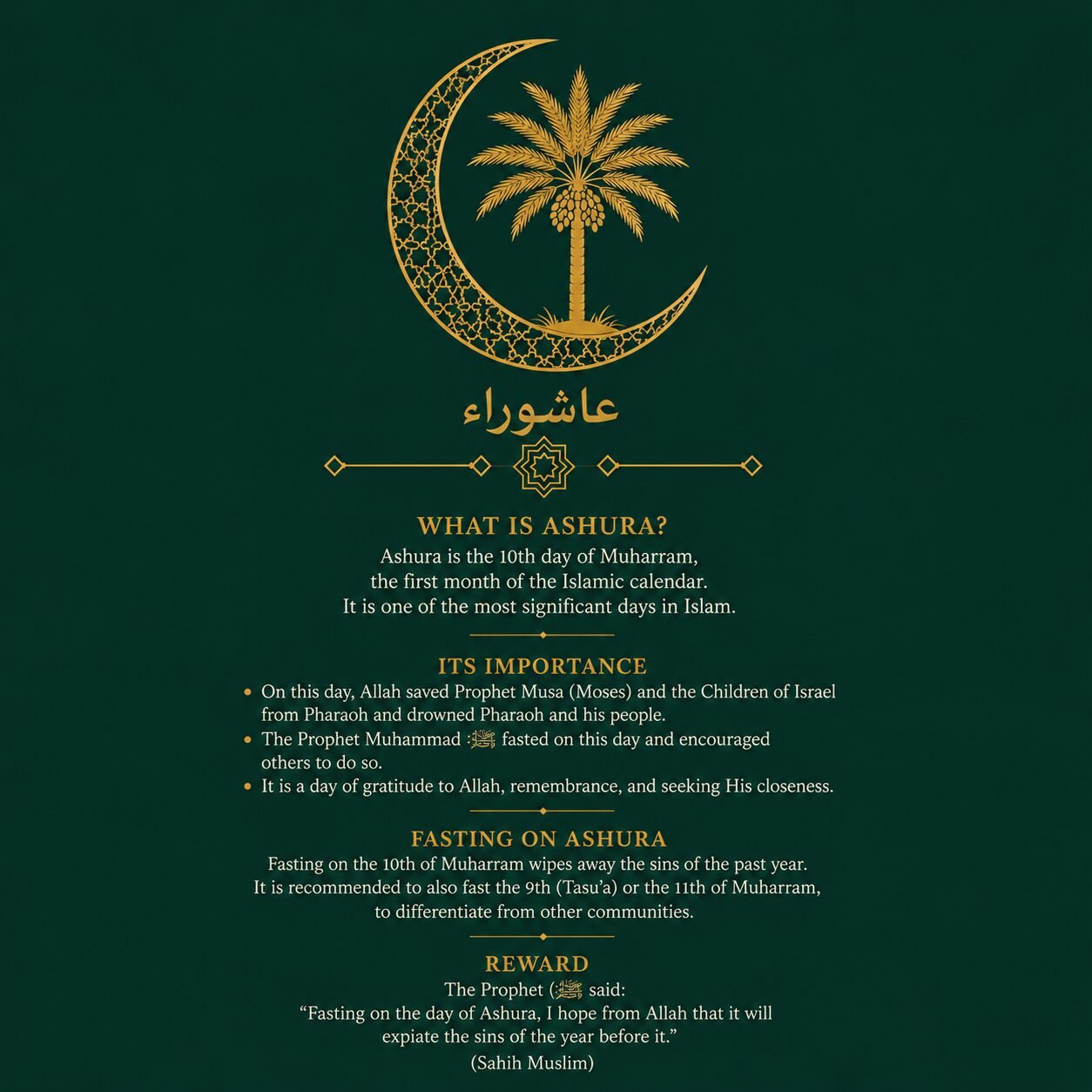
Ashura — from the Arabic ʿasharah (عشرة), meaning ten — is the 10th day of Muharram. The word 9th Muharram is called Tasu'a (تاسوعاء), from tāsiʿ, meaning ninth.
Among the events associated with this day in Islamic tradition: the day Prophet Musa (Moses, AS) and the Israelites were delivered from the tyranny of Pharaoh as they crossed the sea. When the Prophet ﷺ arrived in Madinah, he found the Jews of Madinah fasting on this day and asked them why.
Hadith — Sahih al-Bukhari 2004 · narrated by Ibn Abbas (RA)
When the Prophet ﷺ arrived in Madinah, he found the Jews fasting on the day of Ashura. He asked: "What is this day on which you fast?" They said: "This is a great day. On this day, Allah saved Musa and his people and drowned Pharaoh and his people. Musa fasted on this day out of gratitude, and so we fast on it." The Prophet ﷺ said: "We are more deserving and closer to Musa than you." So the Prophet ﷺ fasted on that day and ordered [Muslims] to fast on it.
Sahih al-Bukhari 2004 · Sahih Muslim 1130a — MutawātirIs fasting on Ashura obligatory?
No. The scholars unanimously agree it is Sunnah Mu'akkadah — a strongly recommended voluntary act of worship, not an obligation. This was not always the case: in the early period in Madinah, before Ramadan was made obligatory, fasting Ashura was required. When the fast of Ramadan was prescribed, Ashura reverted to recommended status.
Hadith — Sahih al-Bukhari 2001 · narrated by 'A'ishah (RA)
"Whoever wishes to fast [on the day of Ashura] may do so; and whoever wishes to leave it may do so."
Sahih al-Bukhari 2001 — authentic statement of the Prophet ﷺWhat is the reward for fasting Ashura?
Hadith — Sahih Muslim 1162b · narrated by Abu Qatadah (RA)
The Messenger of Allah ﷺ was asked about fasting on the day of Ashura. He replied: "It expiates [the minor sins of] the year before it."
Sahih Muslim 1162b — SahihScholars clarify: this expiation covers minor sins only. Major sins (kabā'ir) require sincere, specific tawbah (repentance) in their own right. The expiation is also conditional on avoiding major sins during the year — as indicated in the parallel ruling for the fast of Arafah (Sahih Muslim 1162a).
The three levels of fasting — which applies to you?
Scholars across the four Sunni schools agree on a clear hierarchy. Imam al-Nawawi documented this in his commentary on Sahih Muslim, and it was further affirmed by Ibn Taymiyyah and Ibn Hajar al-Asqalani.
Fast the 9th, 10th, and 11th
Three consecutive days — 24, 25, 26 June 2026. The fullest practice, combining all scholarly recommendations.
Most CompleteFast the 9th and 10th (Tasu'a + Ashura)
The recommended Sunnah — 24 & 25 June 2026. This is what the Prophet ﷺ intended when he said: "If I live until next year, I will fast on the ninth." (Sahih Muslim 1134a)
Recommended SunnahFast the 10th and 11th
Also acceptable — 25 & 26 June 2026. Adding the 11th instead of the 9th still distinguishes your fast from that of others.
Also AcceptableFast the 10th only
Permissible with no sin — 25 June 2026. The British Fatwa Council confirmed: fasting on the 10th alone is valid and carries reward.
Permissibleإِنَّ فَضَائِلَ هَذَا الْيَوْمِ كَثِيرَةٌ
"The best of fasts after Ramadan is Muharram — the Month of Allah." — Sahih Muslim 1130c
Why did the Prophet ﷺ want to add the 9th?
The story behind Tasu'a is documented in a single hadith that transformed how Muslims observe this month forever.
Hadith — Sahih Muslim 1134a · narrated by Ibn Abbas (RA)
When the Prophet ﷺ fasted on the day of Ashura and commanded people to fast, they said: "O Messenger of Allah, this is a day that is venerated by the Jews and Christians." The Prophet ﷺ said: "Next year, if Allah wills, we will fast on the ninth day too." But by the time the following year came, the Messenger of Allah ﷺ had passed away.
Sahih Muslim 1134a — SahihThis hadith is the sole textual basis for fasting the 9th of Muharram. Because the Prophet ﷺ passed away before fulfilling this intention, scholars treated his expressed wish as a Sunnah — what he willed for the Ummah. Imam al-Nawawi outlines three reasons why adding the 9th is recommended:
| # | Reason (Imam al-Nawawi, Sharh Sahih Muslim) |
|---|---|
| 1 | To differ from the People of the Book who fast the 10th only — the strongest reason according to Ibn Taymiyyah (al-Fatāwā al-Kubrā, Vol. 6) |
| 2 | To join the 10th to another day, just as Friday fasting requires adding another day (combining is more rewarding) |
| 3 | As a precaution — in case the lunar date was calculated incorrectly, fasting the 9th ensures the 10th is covered |
Ashura and the Battle of Karbala
For millions of Muslims worldwide — particularly Shia communities — Ashura carries a second, devastating significance: on 10 Muharram 61 AH (10 October 680 CE), Imam Husayn ibn Ali (RA), the grandson of the Prophet ﷺ, was martyred with his companions in the Battle of Karbala, modern-day Iraq.
He had refused to give his bay'ah (pledge of allegiance) to Yazid ibn Mu'awiyah, believing his leadership to be unjust. Surrounded and denied access to water, Imam Husayn (RA) and approximately 72 of his companions were killed. His stand is remembered across the Muslim world as a defining act of principled resistance to tyranny.
The sacredness of Ashura in Islamic tradition — established years before Karbala — was not created by this event. But for much of the global Ummah, 10 Muharram now carries the weight of both: the salvation of Musa (AS) and the martyrdom of Husayn (RA). Both deserve sincere reflection.
What to do on 9th and 10th Muharram
Beyond the fast, there are established, authenticated practices for these days — and some non-established ones that have drifted into common practice without basis.
Fast
The primary act. Fast the 9th and 10th together where possible — the reward is expiation of the preceding year's minor sins (Sahih Muslim 1162b).
Spend on Family
The Prophet ﷺ indicated that being generous to your family on Ashura brings barakah for the year. (Narrated by Ibn Mas'ud; referenced in al-Bayhaqī's Shu'ab al-Īmān)
Recite Quran
Any Quran recitation is elevated in a sacred month. Increase your daily portion — even one extra juz' carries multiplied reward in Muharram.
Give Sadaqah
Charity in the sacred month is among the most rewarding acts of the year. Any amount, given sincerely, is a major deed on this day.
Increase Dhikr
SubhanAllah, Alhamdulillah, Allahu Akbar, and istighfar — consistent dhikr on these days multiplies in reward during Ashur al-Hurum (the sacred months).
Reflect on Karbala
Whether through reading, listening to a khutbah, or quiet reflection — contemplating Imam Husayn's (RA) stand against injustice is spiritually meaningful for the whole Ummah.
How to observe the Ashura fast — step by step
- Make your niyyah (intention) before Fajr. A voluntary fast requires intention before dawn. No specific words are necessary — sincerity in the heart suffices.
- Eat suhoor if possible. It is a Sunnah of all voluntary fasts. Even a glass of water before Fajr fulfils this recommendation.
- Abstain from food, drink, and all invalidators from Fajr to Maghrib — the same rules as Ramadan apply to any voluntary fast.
- Break your fast at Maghrib with dates and water before eating, following the general Sunnah of iftar.
- If you forget and eat accidentally, your fast is still valid — continue and complete it. This applies to voluntary fasts under the majority scholarly opinion (Hanafi, Shafi'i, Maliki).
- There is no specific dua for Ashura. Make any dua, with extra focus on seeking forgiveness, mercy, and gratitude — this is the spirit of the day.
Misconceptions about Ashura — cleared
IslamicFinder and several other ranking sites note these, but none lists them with direct scholar citations. Here they are, sourced.
❌ Myth 1 — Bathing on Ashura prevents illness all year
Cleared No authentic hadith supports this. Ibn Taymiyyah explicitly declared such narrations fabricated (mawḍūʿ) in Majmūʿ al-Fatāwā (25/299).
❌ Myth 2 — Applying kohl (surma) on Ashura prevents eye disease
Cleared No basis in authentic hadith. The narration sometimes cited for this is classified as fabricated by hadith scholars.
❌ Myth 3 — A special meal must be prepared and distributed on Ashura
Cleared There is no specific food or distribution obligation on Ashura. Charity and spending on family are recommended — but the idea of a particular dish is not established in authentic sources.
❌ Myth 4 — The Day of Judgement will occur on a Friday, 10th Muharram
Cleared Knowledge of the Day of Judgement is known only to Allah (Surah Al-A'raf 7:187). No hadith establishes this as a confirmed event or sign. Treat any such claim with caution.
❌ Myth 5 — Fasting on the 10th only is disliked or sinful
Cleared Imam al-Kasani al-Hanafi, Imam al-Mardawi al-Hanbali, and Imam al-Shirwani al-Shafi'i all stated that fasting only on the 10th is not disliked. The British Fatwa Council confirmed the same position (2026 ruling).
❌ Myth 6 — Ashura is an occasion for celebration, festivities, or excessive joy
Cleared Ibn Taymiyyah explicitly rejected both excessive mourning (associated with certain Shia practices) and festive celebration on Ashura, stating neither was practised by the Prophet ﷺ (Fatāwā al-Kubrā). The day's primary observance is fasting, reflection, and increased worship.
Ashura across the Muslim community in the UK
Britain's Muslim communities are diverse — South Asian Sunni communities, Arab communities, and British Shia communities all observe Ashura, and their practices reflect genuinely different scholarly traditions rooted in centuries of Islamic jurisprudence.
For most British Sunni communities — the majority in the UK — Ashura is primarily observed through fasting on the 9th and 10th of Muharram, with increased charity, Quran recitation, and remembrance of the Prophet Musa's (AS) deliverance.
For British Shia Muslims, Ashura is the culmination of the Mourning of Muharram — ten days of gathering, remembrance, and lamentation for the martyrdom of Imam Husayn (RA) at Karbala. Majālis (commemorative gatherings), elegies (marāthī), and reflection on justice, sacrifice, and loyalty to truth are central. Many British Shia mosques and Husayniyyas in London, Birmingham, and Manchester hold public gatherings through the first ten days.
Both traditions have deep, legitimate scholarly roots. The month's shared foundation — reverence for Ahl al-Bayt, rejection of oppression, and increased worship in a sacred month — is common ground for the whole Ummah.
Frequently asked questions
QWhen is Ashura 2026 in the UK?
Ashura (10th Muharram 1448 AH) falls on Thursday 25 June 2026 in the UK, based on the confirmed moon sighting that began Muharram on 16 June 2026. The 9th Muharram (Tasu'a) was Wednesday 24 June 2026. Always confirm with your local mosque, as a one-day variation is possible in some areas.
QWhat is the reward of fasting on Ashura?
The Prophet ﷺ said it expiates the minor sins of the year before it (Sahih Muslim 1162b). Scholars clarify this covers minor sins only — major sins (kabā'ir) require sincere, specific tawbah. The expiation is additional to, not a substitute for, repentance.
QCan I fast only on the 10th of Muharram without the 9th?
Yes — it is permissible and carries reward. The British Fatwa Council (2026 ruling) confirmed there is no sin in fasting only on the 10th. However, fasting both the 9th and 10th is better, following the Prophet's ﷺ expressed intention (Sahih Muslim 1134a).
QIf I couldn't fast yesterday (9th Muharram), can I fast today (10th) alone?
Yes. Fasting the 10th alone is entirely permissible and carries the Ashura reward. If you can also fast tomorrow (11th Muharram / 26 June) as well, that makes it the 10th and 11th option — also a valid and rewarded combination according to scholars including Imam al-Nawawi.
QDid I miss the niyyah for the fast? Can I still make the intention now?
For a voluntary fast, the Hanafi school allows making the intention before the midday point (Zawal), provided you have not eaten since Fajr. The Shafi'i, Maliki, and Hanbali schools generally require the intention before Fajr. Follow your madhab's ruling — if in doubt, ask your local Imam.
QIs the Ashura fast connected to Karbala?
No — the Ashura fast pre-dates Karbala by over fifty years. The Prophet ﷺ established fasting on Ashura during his time in Madinah (around 1–2 AH) to commemorate Allah's deliverance of Prophet Musa (AS) from Pharaoh. Karbala occurred in 61 AH / 680 CE. The two events share the same calendar date but are historically and theologically separate.
QCan I fast Ashura if I have missed days of Ramadan to make up?
Scholars differ on this. The Shafi'i school holds that whoever has missed Ramadan fasts should prioritise making those up before performing voluntary fasts. The Hanafi school allows voluntary fasts even while having Ramadan fasts to make up, though making up the obligatory fasts first is preferred. Check with your local scholar or follow your madhab's ruling.
QWhat should I do if I'm too ill to fast on Ashura?
If genuine illness prevents you from fasting, leave the fast — there is no fidyah or expiation required for a voluntary fast that couldn't be completed due to illness. Allah says: "Allah does not burden a soul beyond what it can bear" (Surah Al-Baqarah 2:286). Make the most of the day with dhikr, Quran, charity, and dua instead.
Before you close this page
If Ashura 2026 has already passed by the time you read this, the month of Muharram is still with you — and every voluntary fast in this month carries elevated reward. The Prophet ﷺ said that the best voluntary fasting after Ramadan is Muharram, so even a Monday or Thursday fast during this month carries more weight than in other months.
If you managed to fast today — even the 10th alone — that is the Sunnah honoured. If you intend to fast the 11th tomorrow as well, make your niyyah before Fajr tonight.
May Allah accept from all of us. Ameen.