

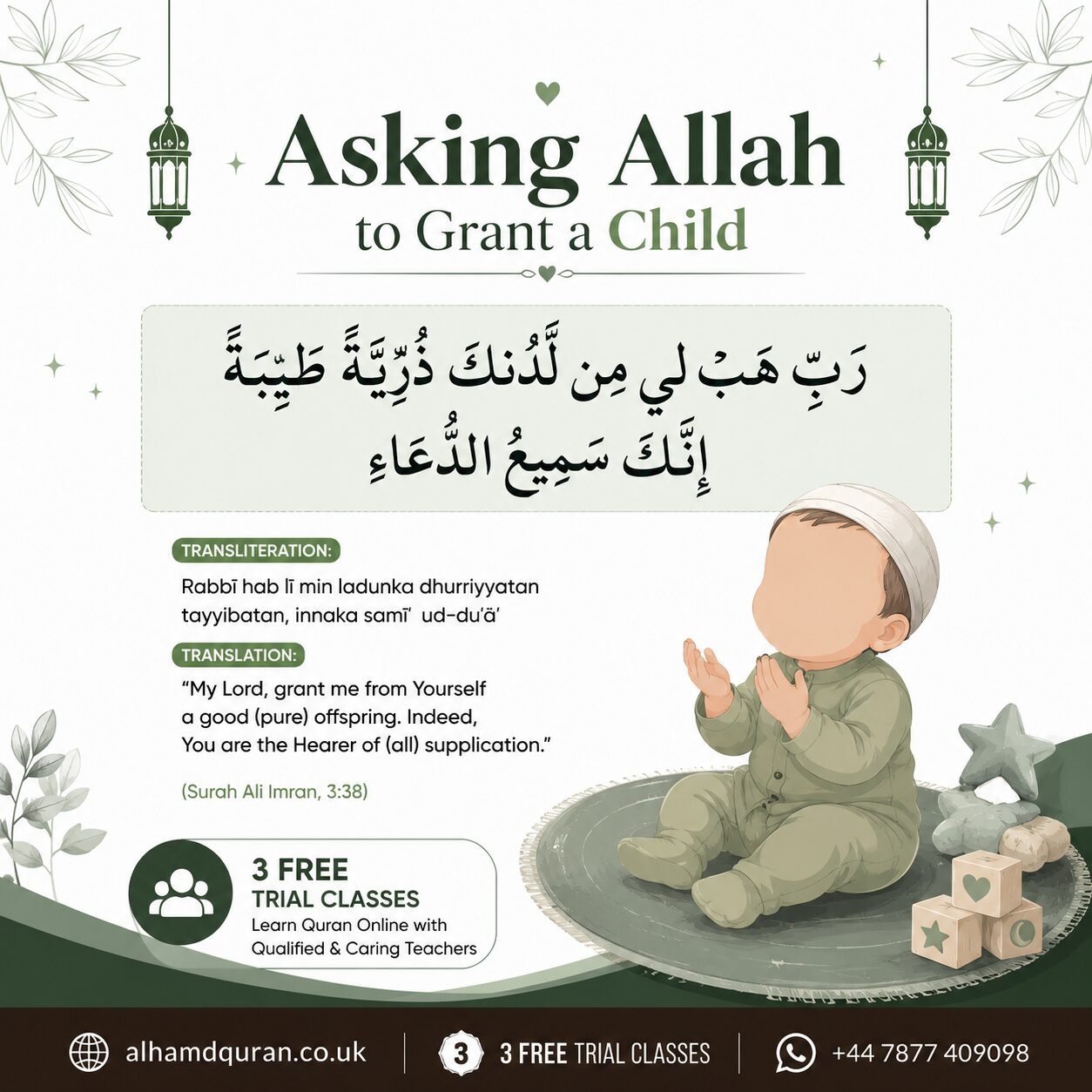
Dua for Having a Child in Islam
✦ Key Takeaways from This Article
- The primary Quranic dua for having a child comes from Surah Ali 'Imran (3:38), made by Prophet Zakariyya (AS)
- Seeking forgiveness (Istighfar) is explicitly linked in the Quran (71:10-12) to being blessed with children
- Surah Al-Furqan (25:74) contains a powerful dua asking for righteous offspring and a comfortable family life
- Prophet Zakariyya (AS) made dua for a child in old age with a barren wife — and Allah answered miraculously
- The best times for this dua: last third of night (Tahajjud), in Sujood, and between Adhan and Iqamah
- Islam teaches that dua is never lost — it is either granted, rewarded in the Hereafter, or used to remove harm
A Heart's Deepest Prayer: Dua for Having a Child in Islam
There is a kind of longing that words struggle to hold — the longing for a child. It is one of the most human aches in existence: to hold a small hand, to see your eyes reflected in another face, to witness a new soul step into a world you've been preparing for them. And for the believing Muslim, this longing is not merely biological. It is spiritual.
You are reading this because somewhere in your heart, you are asking Allah for something precious. Perhaps you have been married for years without news of a child. Perhaps you have faced loss. Perhaps you are simply a parent praying for righteous children in a world that makes righteousness difficult. Perhaps you are a new Muslim who wants their children to carry the light of Islam forward.
Wherever you are in that journey — this article is for you.
The dua for having a child in Islam is not a formula. It is not a magic combination of Arabic syllables. It is an act of tawheed — the profound recognition that only Allah gives life, that only He opens and closes the doors of provision, and that the heart which turns to Him in sincerity will never be left unanswered — even if the answer takes a form we did not expect.
In this guide, you will find the authentic Quranic duas, the moving story of Prophet Zakariyya (AS), and practical spiritual steps — drawn entirely from the Quran and the Sunnah — to support your heart as you make this most beautiful of prayers.
Children in Islam: A Gift, a Trust, and a Sign of Allah's Mercy
Before we come to the duas themselves, it is worth pausing to understand what Islam says about children — because the understanding shapes the dua.
Allah says in the Quran: "Wealth and children are the adornment of the worldly life." Surah Al-Kahf, 18:46 The Arabic word used — zīna — means beauty, adornment, the thing that makes something radiant. Children are not just a societal norm or a biological outcome. In the Islamic worldview, they are among the most luminous gifts Allah can place in a life.
And yet — with extraordinary wisdom — the Quran also says: "To Allah belongs the dominion of the heavens and the earth. He creates what He wills. He gives to whom He wills female children, and He gives to whom He wills male children. Or He makes them of both sexes, male and female, and He renders whom He wills barren. Indeed, He is Knowing and Competent." Surah Ash-Shura, 42:49-50
This is one of the most profound verses in the Quran. Allah is not withholding children from a couple because of their unworthiness. He is distributing His decree according to a wisdom that is beyond our sight. And in His infinite wisdom, He made the dua — the turning to Him in prayer — the very gateway through which His gifts flow.
The Prophet Muhammad ﷺ said: "Dua is worship." — Hadith, Abu Dawud & At-Tirmidhi (authenticated)
When you make dua for a child, you are not begging. You are worshipping. You are doing exactly what you were created to do.
The Story of Prophet Zakariyya (AS): When the Impossible Became Certain
If you wish to understand the dua for having a child in Islam in its full depth, you must sit with the story of Prophet Zakariyya (AS). It is the most detailed, most moving account of a believer asking Allah for a child — and it is preserved forever in the Book of Allah.
Zakariyya (AS) was a prophet of Allah, responsible for the guardianship of the young Maryam — the mother of Prophet Isa (AS). He was, by any human measure, old. His bones had weakened. His hair had turned white. He himself describes his condition in the Quran with a tenderness that reaches across centuries: "My Lord, indeed my bones have weakened, and my head has filled with white." Maryam, 19:4
His wife was barren. They had been married for years. By every natural calculation — by every standard of what was medically, biologically, humanly possible — a child was out of reach.
And yet. He made dua.
The Quran tells us that he called upon his Lord "secretly" Maryam, 19:3 — in the private depth of the night, not in a performance of piety, but in a genuine, trembling conversation with Allah. He acknowledged his weakness. He acknowledged his wife's barrenness. And then, with the full certainty of a man who knew Allah, he said: "Grant me from Yourself an heir."
And Allah — the One who says "Be" and it is — answered. Not with a miracle after years of silence. But immediately. The angels called out to Zakariyya while he stood in prayer and announced the imminent birth of Yahya (AS) — a prophet whom Allah Himself would name, a child who had never had a namesake before.
This is the message encoded in the story: When a heart turns to Allah with sincerity, no condition is too impossible, no age too late, no medical report too final. The laws of biology are Allah's creation — and He is not bound by His own creation.
The Primary Dua for Having a Child in Islam (From the Quran)
Dua 1: The Dua of Prophet Zakariyya (AS) — Surah Ali 'Imran
This is the most concise, most authentic, and most directly answered dua for a child in the entire Quran. It should be memorized, understood, and repeated with sincerity:
Notice what Zakariyya (AS) asks for: not just any child — but a good offspring (dhurriyyatan ṭayyibah). The Arabic word ṭayyib carries the meaning of pure, wholesome, and righteous. He is asking for a child who will be a blessing in this world and the next. This is a reminder that the best dua is not simply for a child — but for a righteous child.
Dua 2: The Extended Dua of Zakariyya (AS) — Surah Maryam
This longer dua teaches us something vital about how to make dua: Zakariyya (AS) presented his situation honestly to Allah. He didn't pretend it wasn't difficult. He described his weakness, his wife's condition, his concerns — and then made his request. This is the etiquette of dua: not performing strength before Allah, but bringing your actual self — your fears, your ache, your hope — into His presence.
More Powerful Duas from the Quran
Dua 3: The Dua of the Righteous — For a Righteous Family
This dua, recorded in Surah Al-Furqan as one of the characteristics of the servants of the Most Merciful, is a profound supplication — asking not just for children, but for children who are a comfort to the eyes, and for family life to be marked by righteousness:
The phrase qurrata aʿyun — "comfort to our eyes" — is extraordinary in Arabic. It refers to the kind of joy that makes the eye cool, settled, at peace. It is the opposite of the restless, burning eye of one whose longing has not been met. This dua asks for children who will bring that kind of deep peace — children whose righteousness will make you proud in this life and whose prayers will reach you after your death.
Dua 4: Zakariyya's Cry in Surah Al-Anbiya
This dua captures the raw honesty of the believing heart. "Do not leave me alone." It is the recognition that aloneness — not having a child to carry the light forward — is a real and legitimate concern, and that it is perfectly permissible to bring that fear to Allah directly. There is no performance here. Only truth.
The Quranic Secret: Seeking Forgiveness as a Path to Children
This is perhaps the most surprising and most powerful spiritual insight in this entire guide — and it comes directly from the Quran itself.
In Surah Nuh, Allah preserves the advice that the Prophet Nuh (AS) gave to his people. He did not begin by telling them to make dua for rain or wealth or children directly. He told them something else:
Read this again slowly. The Prophet Nuh (AS) told his people: seek forgiveness — and as a direct consequence, Allah will give you children. This is not metaphor. This is divine instruction preserved in the Quran. Istighfar — the sincere seeking of forgiveness — removes spiritual barriers, opens closed doors, and invites Allah's mercy into the areas of life where we feel most stuck.
Scholars of Islam, including Ibn Qayyim al-Jawziyyah (rahimahullah), have written extensively on this: that many of the blessings people seek — including children, provision, and health — are blocked by sins, and that the key to unlocking them is sincere, abundant Istighfar. The recommended practice is to say Astaghfirullah — "I seek forgiveness from Allah" — as many times as possible each day, especially after Fajr and before sleeping.
Practical Spiritual Steps: How to Make Dua for a Child
Islam is a complete way of life. It pairs dua with action. Here are the recommended spiritual practices — drawn entirely from the Quran and Sunnah — that will strengthen your supplication and open the door of Allah's mercy:
-
1Pray Tahajjud and Make Dua in the Last Third of the Night The Prophet ﷺ said that Allah descends to the lowest heaven in the last third of every night and asks: "Who is calling upon Me that I may answer?" (Sahih Bukhari & Muslim). Wake before Fajr, pray two units (raka'at) of Tahajjud, and make your dua for a child at this time with full sincerity. This is the most powerful time for any dua.
-
2Make Dua in Sujood (Prostration) During Prayer The Prophet ﷺ said: "The closest a servant is to his Lord is when he is in prostration." (Sahih Muslim). When you put your forehead to the ground in submission, you are at your nearest point to Allah. Pour your dua for a child into your sujood — it does not need to be in Arabic at this moment; speak to Allah in your own language with your whole heart.
-
3Give Sadaqah (Charity) With the Intention of Opening Doors Sadaqah removes hardship and invites blessings. The Prophet ﷺ said: "Sadaqah extinguishes sin as water extinguishes fire." (At-Tirmidhi). Giving charity — even if it is small and consistent — with the intention of having your dua for children answered is a deeply recommended practice in Islamic spiritual tradition.
-
4Increase Istighfar Daily — As Many Times As Possible Based on Surah Nuh (71:10-12) discussed above, make Istighfar a constant companion. Say "Astaghfirullah wa atoobu ilayh" (I seek forgiveness from Allah and repent to Him) 100 times after Fajr and 100 times after Asr. The Prophet ﷺ himself sought forgiveness more than 70 times a day despite being sinless — as a demonstration of its power and importance.
-
5Read Surah Maryam Regularly Surah Maryam contains the story of Zakariyya (AS) receiving his son despite all odds, and Maryam (AS) giving birth to Isa (AS) miraculously. Many scholars and Islamic traditions recommend the regular recitation of Surah Maryam for those seeking children. Its blessings in this regard are widely acknowledged in classical Islamic scholarship.
-
6Make Dua in the Times That Are Never Rejected Beyond Tahajjud, make your dua: in the time between Adhan and Iqamah; on Fridays between Asr and Maghrib; during rain; on the Day of Arafah (9th Dhul Hijjah); and throughout Ramadan — especially on Laylatul Qadr. These windows of acceptance are confirmed in authentic hadith.
-
7Ask With Certainty — Not Doubt The Prophet ﷺ said: "When one of you makes dua, let him ask with determination and not say 'O Allah, grant me if You wish' — for there is no one who can compel Allah." (Sahih Bukhari & Muslim). Make your dua with the full conviction that Allah hears and answers. Ask clearly: "O Allah, grant me a righteous child." No hedging. No apologizing for the size of the ask.
-
8Combine Dua with Seeking Medical Advice Islam does not ask us to abandon medical means in favour of spiritual ones — it asks us to use both. The Prophet ﷺ said: "Make use of medical treatment, for Allah has not made a disease without appointing a remedy for it." (Abu Dawud). Consult fertility specialists, take care of your health, and make dua simultaneously. Both are acts of trust in Allah.
When the Answer Comes Differently: A Word for Those Still Waiting
This section is for you if you have been making dua for years, and the child you have been praying for has not yet come. This section is written with deep care, and with the Quran as its guide.
The Prophet Muhammad ﷺ said, in a hadith reported by Ahmad and al-Hakim:
"There is no Muslim who makes dua — so long as he does not make dua for something sinful, or for the cutting of family ties — except that Allah gives him one of three things: either He answers his dua immediately, or He stores it for him in the Hereafter, or He removes from him an equivalent harm." — Hadith, authenticated by Al-Albani
Read this carefully. Your dua for a child is not wasted. It cannot be wasted. Allah has made it impossible for a sincere dua to go unacknowledged. The believer who prays for a child and waits years — that waiting is not silence from Allah. It is a different kind of conversation. Every prayer is accumulating. Every tear on the prayer mat has been seen. The delay is not rejection — it is a divine arrangement of timing that your insight cannot yet see.
And for some, Allah may provide the blessing of children through avenues that weren't expected: through adoption, through becoming a guardian, through teaching and mentoring children in the community. The Quran tells us Allah gives "to whom He wills" — and His wisdom encompasses what we cannot imagine.
Allah says: "And your Lord said, 'Call upon Me; I will respond to you.'" — Surah Ghafir, 40:60
This is a direct promise from Allah Himself. Not conditional. Not qualified. Call upon Me — and I will respond. Continue calling. Do not allow the passage of time to sever the rope between your heart and your Lord. The rope is real. The answer is certain. The timing is His.
When Allah Blesses You with a Child: The First Gift You Can Give Them
If you are reading this in the hope of a child, this section is a pledge you can make to Allah today — a vow of intention about the kind of parent you will be when He answers your dua. And if you already have children, this is for you right now.
The Prophet ﷺ said: "The best of you are those who learn the Quran and teach it." (Sahih Bukhari). The greatest gift you can give the child Allah blesses you with — the very first act of love you can perform for them — is to connect them to the Book of Allah.
Research consistently shows that children who begin learning Quran between the ages of 3 and 5 develop a natural familiarity with Arabic sounds that becomes increasingly difficult to acquire later in life. The neuroplastic window of early childhood is precisely when the seeds of Quranic recitation take root most deeply.
At AlHamdQuran Academy, we have had the honour of teaching children as young as 3.5 years old — beginning their Quranic journey through the Noorani Qaida method, with certified female tutors, one-to-one online sessions, and the patience and love that every young learner deserves. Make the intention today — and when Allah answers your dua, be ready to honour it.
Begin Their Quranic Journey Today
Whether your child is 3 years old or starting as an adult — our certified tutors are waiting to welcome them. Start with 3 completely free trial classes, no commitment required.
Claim 3 Free Trial Classes →Available 7 days a week · Male & female tutors · All ages welcome
A Closing Reflection: Your Dua Has Already Reached Allah
The moment you turned your face to Allah and asked for a child — He heard you. Before the words formed in your heart, before the tears came to your eyes, before your hands lifted in prayer — He already knew. He was already preparing an answer in a form only He can design.
Prophet Zakariyya (AS) was old. His wife was barren. The situation was humanly impossible. And yet the Quran — Allah's own preserved words — records that he asked. And the Quran records that Allah answered. The same Allah. The same mercy. The same power that has not diminished by a single degree since the day He said "Be" to the universe.
Make the dua. Make it again. Make it in the night when no one sees you. Make it with the Arabic words preserved in this article. Make it in your own mother tongue with your own broken words. Increase your Istighfar. Give in sadaqah. Read Surah Maryam. Pray Tahajjud. Do everything within your reach — and then trust, with the certainty of a believer, that what is in Allah's reach is infinitely greater.
The Prophet ﷺ said: "No calamity befalls a Muslim — not even the prick of a thorn — except that Allah removes with it some of his sins." Every day of waiting is not a day of punishment. It is a day of purification. A day of elevation. A day in which Allah is shaping you — perhaps — into the very kind of parent that the child He is preparing for you will need.
May Allah bless your home with righteous children who are a comfort to your eyes, a shade in your old age, and a source of reward that flows to you long after you have returned to Him.
آمين يا رب العالمين
Ameen. O Lord of all the worlds.
Frequently Asked Questions
The most directly authenticated dua for having a child in Islam is the supplication of Prophet Zakariyya (AS) in Surah Ali 'Imran (3:38): "Rabbi hab lī min ladunka dhurriyyatan ṭayyibatan, innaka samīʿu d-duʿāʾ" — "My Lord, grant me from Yourself a good offspring. Indeed, You are the Hearer of supplication." This dua was answered by Allah with the miraculous birth of Prophet Yahya (AS), making it the most powerful and authenticated dua for this purpose in the Quran.
Scholars recommend reading Surah Maryam (Chapter 19) regularly, as it contains the full story of Prophet Zakariyya (AS) being granted Yahya (AS) despite his wife being barren, and Maryam (AS) giving birth to Isa (AS) miraculously — both extraordinary births granted by Allah. Surah Ali 'Imran (Ayah 38) also contains Zakariyya's directly answered dua.
Yes — and this is directly stated in the Quran. In Surah Nuh (71:10-12), Allah preserved Prophet Nuh's advice to his people: "Ask forgiveness of your Lord — He will send rain upon you in abundance, and give you increase in wealth and children." Islamic scholars unanimously recommend abundant Istighfar as a means of removing spiritual barriers to receiving Allah's blessings, including the blessing of children.
The most powerful times for this dua are: (1) The last third of the night (Tahajjud time) — when Allah descends and says "Who is calling upon Me?"; (2) During Sujood in Salah — the closest point to Allah; (3) Between the Adhan and Iqamah; (4) On Fridays between Asr and Maghrib; (5) On the Day of Arafah; (6) During Ramadan, especially on Laylatul Qadr. All of these are confirmed in authentic hadith as times when dua is especially likely to be accepted.
The dua is: "Rabbanā hab lanā min azwājinā wa-dhurriyyātinā qurrata aʿyunin wa-jʿalnā lil-muttaqīna imāmā" — "Our Lord, grant us from among our wives and offspring comfort to our eyes, and make us a leader for the righteous." (Surah Al-Furqan, 25:74). This powerful dua asks for children who will be a source of deep joy and for family life marked by righteousness.
Absolutely, and it is encouraged. The Quran records multiple prophets — Zakariyya (AS), Ibrahim (AS), and Nuh (AS) — making dua for children. Islam teaches that children are a blessing (ni'mah) from Allah, and asking Him for this blessing is an act of tawheed — recognition that only Allah grants life. The Quran itself teaches us the words of these duas, which is an implicit invitation to use them.
Islam teaches that dua is never lost. The Prophet ﷺ said that every sincere dua is either answered immediately, stored as reward in the Hereafter, or used to remove an equivalent harm. Continue making dua with certainty, increase Istighfar, give in sadaqah, and maintain your prayers. Also consider seeking medical advice alongside your spiritual practice. The delay is not rejection — it is a divine timing beyond our current sight.
You can use the transliterations provided in this article until you memorize the Arabic. Additionally, the Prophet ﷺ confirmed that dua can be made in any language — Allah understands every tongue. You can make your personal, heartfelt dua in English, Urdu, Punjabi, Turkish, or any language you speak natively. The Arabic duas from the Quran are especially powerful and worth learning — and learning Arabic through the Quran is itself an act of worship.
AlHamdQuran Academy · alhamdquran.co.uk · Complete SEO Blog Post with Schemas, AEO & GEO Optimization
Internal URL: /dua-for-having-a-child-in-islam/ · Primary Keyword: dua for having a child in Islam · June 2026