
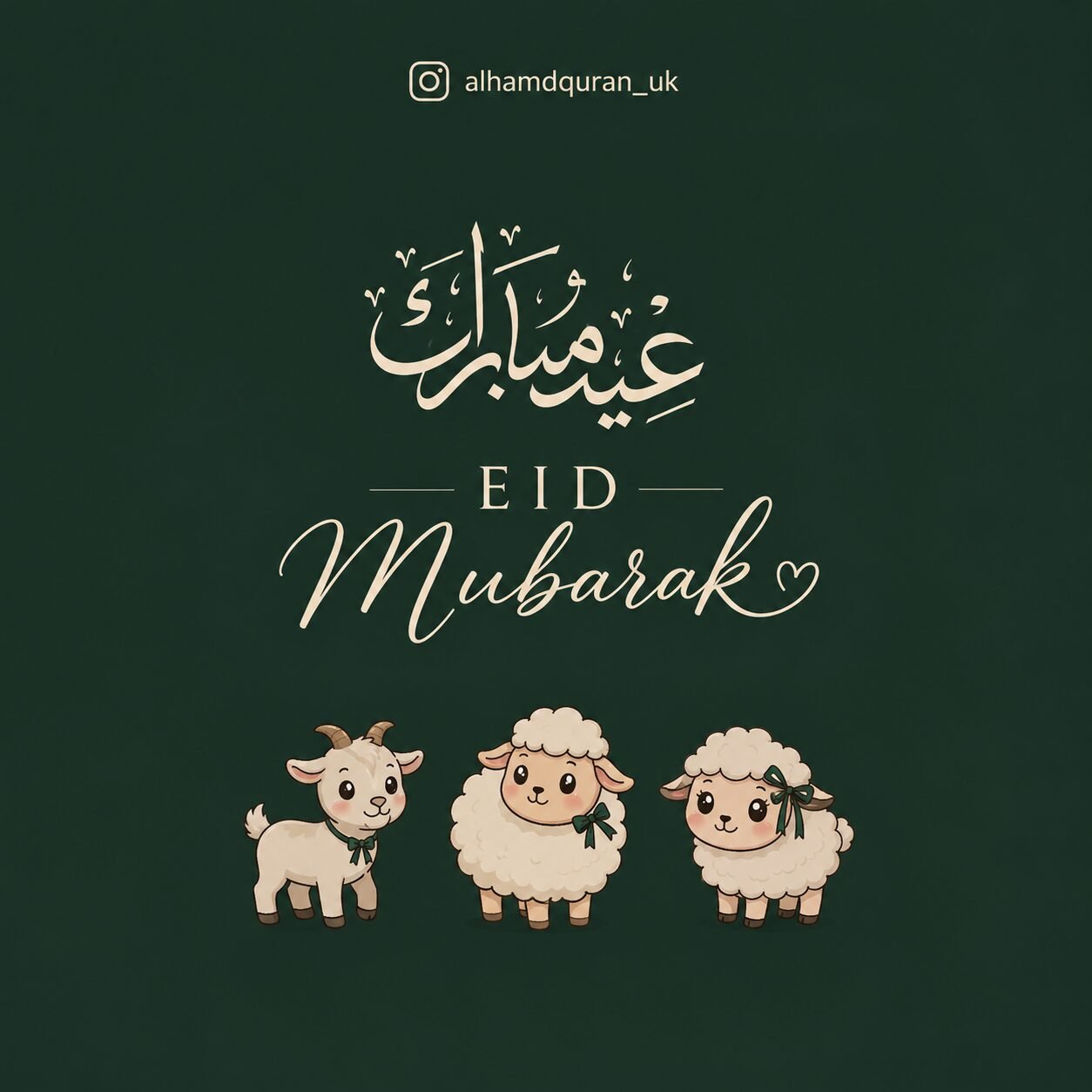
Mubarak
May Allah accept your prayers, fasting, and good deeds. May this Eid bring peace, barakah, and joy to you and your entire family.
Everything About Eid Mubarak
- Eid Mubarak means "Blessed Celebration" — a greeting Muslims share on the day of Eid.
- Eid al-Adha falls on the 10th of Dhul Hijjah, the day after the blessed Day of Arafah.
- The best greeting to give on Eid is Taqabbal Allahu minna wa minkum — "May Allah accept from us and from you."
- Eid al-Adha commemorates Prophet Ibrahim's (AS) willingness to sacrifice and Allah's mercy in sending a ram in place of his son.
- The sunnah of Eid includes Ghusl, wearing best clothes, Eid Salah, Takbeer, visiting family, and giving Sadaqah.
- Qurbani (the sacrifice) is wajib for those who meet the nisab threshold and is an act of worship, not just tradition.
The Meaning
What Does Eid Mubarak Mean?
When Muslims across the world greet each other with Eid Mubarak, they are sharing something more than a seasonal phrase. The word Eid in Arabic means "recurring happiness" or "festival," while Mubarak means "blessed." Together, Eid Mubarak means "a blessed celebration" — a prayer that the joy of this day returns again and again with Allah's barakah upon it.
But the scholars explain that the most complete and authentic greeting on the day of Eid is not just "Eid Mubarak." The Companions of the Prophet ﷺ would greet one another with a phrase that carried far deeper meaning — and it is the one we should revive.
Taqabbal Allahu minna wa minkum
"May Allah accept from us and from you"
Narrated by the Companions — Ibn Hajar, Fath al-BariThis greeting is a du'a — a prayer for acceptance. It acknowledges that all the fasting, prayer, Qurbani, and worship we offered were for Allah alone, and we ask Him to accept it from all of us. It is the Sunnah greeting of Eid, and it is far more beautiful than any modern substitute.
Eid al-Adha
The Story and Significance of Eid al-Adha
Eid al-Adha is the second of the two Islamic Eids and is widely considered the greater of the two in terms of significance and reward. It falls on the 10th of Dhul Hijjah — the day immediately following the magnificent Day of Arafah.
At its heart, Eid al-Adha commemorates one of the greatest tests in the history of prophethood. Prophet Ibrahim (AS) was commanded in a dream to sacrifice his beloved son Ismail (AS). Both father and son submitted — Ibrahim raised the knife and Ismail laid his cheek upon the ground. At that precise moment of complete surrender, Allah called out:
"O Ibrahim, you have fulfilled the vision. Indeed, We thus reward the doers of good. Indeed, this was the clear trial. And We ransomed him with a great sacrifice."
— Surah As-Saffat 37:104–107Allah replaced the sacrifice with a ram from Jannah. This act of total tawakkul and submission is what Muslims worldwide commemorate every year through the Qurbani — reminding ourselves that Ibrahim's (AS) legacy is our legacy, and his Lord is our Lord.
Why Eid al-Adha is Called the Greater Eid
Eid al-Adha is called Eid al-Kabir — the Greater Eid — in many Islamic traditions because it follows the greatest days of the Islamic year (the 10 days of Dhul Hijjah), coincides with the Hajj pilgrimage, and involves the act of Qurbani which is among the most beloved deeds to Allah in these days.
Sunnah of Eid
What to Do on the Day of Eid — The Sunnah
The Prophet ﷺ observed Eid with a beautiful and consistent pattern of actions. Here is what is established from the authentic Sunnah for the day of Eid:
- ◆Perform Ghusl (full bath) before Eid Salah — this is confirmed from the practice of the Companions and recommended by the scholars.
- ◆Wear your best clothing — the Prophet ﷺ had a special garment he wore on the two Eids. Dressing well on Eid is an act of gratitude and beauty.
- ◆Make abundant Takbeer — "Allahu Akbar, Allahu Akbar, Lā ilāha illa Allāh, Allahu Akbar, Allahu Akbar, wa lillāhil-hamd." Recite it from Fajr of the 9th to Asr of the 13th of Dhul Hijjah.
- ◆Eat after Eid Salah — unlike Eid al-Fitr where you eat before, on Eid al-Adha the Sunnah is to eat from your Qurbani meat after the prayer.
- ◆Attend the Eid Salah in congregation — the Prophet ﷺ commanded even women and children to attend, showing the communal importance of this prayer.
- ◆Visit family, strengthen ties, and give gifts — Eid is a day of community and mercy. Reconnecting with relatives and spreading joy is deeply encouraged.
- ◆Give Sadaqah and remember the poor — part of the Qurbani meat is to be distributed to those in need. Eid should be felt by everyone in the community.
Eid Greetings
Best Eid Mubarak Greetings in Arabic and English
These are the most authentic and beautiful ways to greet your family, friends, and fellow Muslims on the day of Eid:
Qurbani
Understanding the Qurbani — The Sacrifice of Eid
Qurbani — the ritual sacrifice performed on Eid al-Adha — is one of the most misunderstood acts of Islamic worship in the modern world. It is not simply tradition or cultural practice. It is an act of ibadah commanded by Allah for every Muslim who meets the threshold of nisab (possession of wealth equivalent to 87.48g of gold or 612.36g of silver).
The Prophet ﷺ said: "Whoever has the means to offer a sacrifice but does not do so, let him not approach our musalla (place of prayer)." (Ibn Majah). This is a stern warning that emphasises the weight of Qurbani for those who are financially able.
"It is the Sunnah of your father Ibrahim. For every hair of the Qurbani, you receive a reward from Allah."
— Prophet Muhammad ﷺ · Ibn Majah: 3127The key spiritual lesson of Qurbani is not the blood or the meat — it is the intention and the willingness to give something precious for the sake of Allah, just as Ibrahim (AS) was willing to give the most precious thing he had.
Frequently Asked Questions
Eid Mubarak — Your Questions Answered
What does Eid Mubarak mean in English?
+What is the difference between Eid al-Fitr and Eid al-Adha?
+What is the best Eid Mubarak reply?
+When is Eid al-Adha 2025?
+Is Qurbani obligatory on Eid al-Adha?
+How is Eid Mubarak written in Arabic?
+Begin This Eid With
Spiritual Consistency
Eid is a new beginning. Let this blessed day be the start of the habits, knowledge, and community that carry you through the whole year.
No credit card required · Open to all Muslims globally