

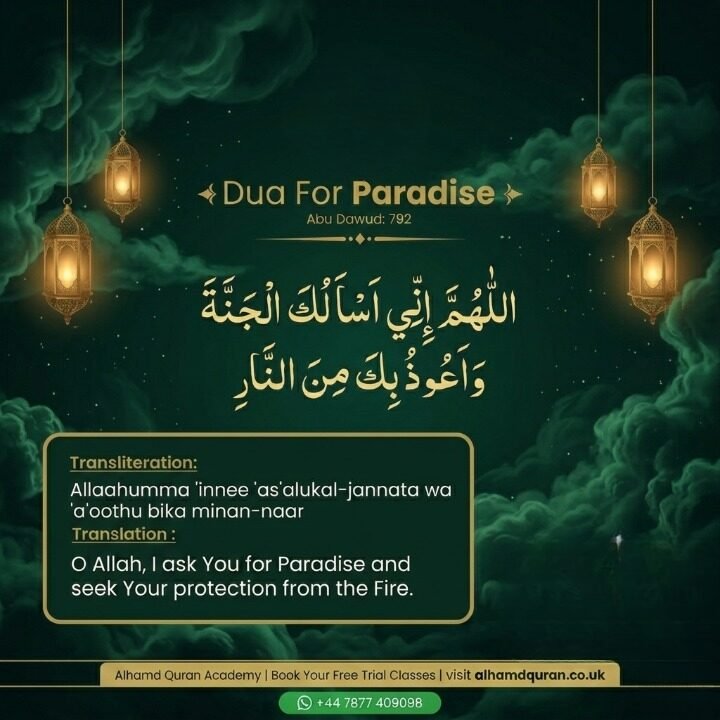
Allāhumma innī as'alukal-jannata wa a'ūdhu bika minan-nār
"O Allah, I ask You for Paradise and I seek Your protection from the Fire."
Abu Dawud: 792 · Authenticated by Scholars
Dua for Paradise The Supplication That Covers Everything
Six words in Arabic. Two requests that encompass everything a Muslim seeks — the ultimate reward and the ultimate protection. This is the dua the Prophet ﷺ never abandoned.
Everything You Need to Know
- The dua for paradise — Allāhumma innī as'alukal-jannata wa a'ūdhu bika minan-nār — is from Abu Dawud 792, authenticated by scholars.
- The Prophet ﷺ endorsed it directly, saying to a Companion reciting it slowly: "You have summarised the matter."
- It is the most comprehensive voluntary supplication in the Sunnah — covering both the ultimate hope and the ultimate fear in one breath.
- Recite it three times after Fajr and Maghrib, in sujood, before sleeping, and in the last third of the night.
- There are five companion duas from authentic hadith that build a complete shield of supplication around this one.
- Understanding the Arabic word-by-word transforms this from routine recitation into conscious worship.
- This dua functions as a daily moral compass — every sincere recitation creates accountability between your lips and your actions.
The Foundation
Why This Dua for Paradise Stands Apart From All Others
In the vast treasury of Islamic supplication, the dua for paradise found in Abu Dawud 792 occupies a position unlike any other voluntary dua in the Sunnah. Its uniqueness does not come from its length — it is deliberately brief. Its power comes from what scholars describe as jam' bayn al-amalay — combining the two fundamental desires of every believer in a single breath.
Every dua a Muslim makes traces back to one of two underlying needs: to gain something good, or to be protected from something harmful. This supplication contains both simultaneously. Asking for Jannah encompasses every conceivable blessing — health, provision, righteous family, a good end, the vision of Allah, eternal peace. Seeking refuge from the Fire encompasses protection from every form of harm, sin, corruption, and punishment.
When the Prophet ﷺ heard a Companion reciting it slowly and deliberately in prayer, his response was not correction — it was confirmation. He said: "You have summarised the matter." That single statement from the Prophet ﷺ is a scholarly endorsement that has been cited for fourteen centuries.
"Ask Allah for Al-Firdaus — it is the middle and highest part of Paradise, and above it is the Throne of the Most Merciful, and from it the rivers of Paradise flow."
— Prophet Muhammad ﷺ · Sahih Bukhari: 2790When we ask for Jannah with the definite article — al-jannata — we are asking for all of it. Not a portion. Not a lower level. Al-Firdaus al-A'la — the highest station — and with it every mercy that flows downward from the Throne of Allah.
Word-by-Word Analysis
What Every Arabic Word Actually Means
One of the most profound ways to deepen your connection with any dua is to understand the exact meaning of every Arabic word. This supplication is seven components — each carrying a specific theological weight that changes how you feel when you recite it consciously.
Allāhumma innī as'alukal-jannata wa a'ūdhu bika minan-nār
"O Allah, I ask You for Paradise and I seek Your protection from the Fire."
Abu Dawud: 792 · Authenticated by Scholars
When these components are understood, what was once a brief daily recitation becomes a conscious theological statement — a full acknowledgment of dependence on Allah, sincerity of hope, and an absolute need for His protection.
Hadith Explanation
The Full Context of Abu Dawud 792
The complete narration in Abu Dawud (792) records that Anas ibn Malik (RA) said: the Prophet ﷺ passed by a man who was saying this dua slowly, with deep concentration, in his prayer. The Prophet ﷺ heard him and said: "You have summarised the matter."
This response — aw jabta, meaning "you have hit the mark" or "compressed it well" — is one of the most significant endorsements in all of hadith literature. It tells us this single supplication captures the entirety of what a Muslim should be asking Allah for. All longer duas, all detailed requests, all specific supplications — they ultimately reduce to these two needs.
A related narration in Abu Dawud (1495) reports the Prophet ﷺ instructed reciting this dua after the final tashahhud in every prayer, before the tasleem. This places it among the most regularly recommended supplications in the Sunnah — not occasional, but daily, structured, and consistent.
"The Prophet ﷺ passed by a man saying: O Allah, I ask You for Paradise and seek refuge in You from the Fire. The Prophet said: You have summarised the matter."
— Abu Dawud: 792 · Narrated by Anas ibn Malik (RA)When to Recite
The Best Times to Make the Dua for Paradise
The Prophet ﷺ did not just teach this dua — he specified when. Understanding these optimal times transforms it from occasional recitation into a structured daily act of worship.
In Sujood
The Prophet ﷺ said: "The closest a servant is to his Lord is in prostration — so increase your dua." Sujood is the apex of this dua's acceptance.
After Every Obligatory Prayer
Recite three times after Fajr and Maghrib specifically, and once after Dhuhr, Asr, and Isha. This is one of the most confirmed post-prayer adhkar.
Last Third of the Night
Allah descends to the lowest heaven and asks: "Who is calling Me? Who is asking Me?" — this is the single most powerful window for this dua's acceptance.
Between Adhan and Iqamah
The Prophet ﷺ said dua between adhan and iqamah is not rejected. This short window before every congregational prayer is a precious opportunity.
Before Sleeping
Making this your last conscious thought aligns your heart with its ultimate purpose and comes under the protection of the night adhkar.
Last Hour of Friday
The scholars widely hold this to be just before Maghrib on Friday — an hour in which dua is answered. Reserve this supplication for that window every week.
Complete Supplication Shield
Five Authentic Duas for Paradise From the Sunnah
The dua from Abu Dawud 792 is the foundation. But the Prophet ﷺ taught several related supplications for Jannah and protection from the Fire. Together they form what scholars call a hisn — a fortress of supplication. These are the five most authenticated:
Allāhumma innī as'alukal-jannata wa a'ūdhu bika minan-nār
"O Allah, I ask You for Paradise and seek Your protection from the Fire."
Abu Dawud: 792 — The Primary DuaThe foundational supplication. Recite after every prayer, in sujood, and before sleep. The Prophet ﷺ confirmed it as comprehensive.
Allāhumma innī as'alukal-jannata wa mā qarraba ilayhā min qawlin aw 'amal
"O Allah, I ask You for Paradise and for whatever brings me closer to it of words and deeds."
Ibn Majah: 3846 — AuthenticatedThis expands the request beyond the destination to include the journey — asking for the words and actions that lead to Jannah itself.
Rabbanā ātinā fid-dunyā ḥasanatan wa fil-ākhirati ḥasanatan wa qinā 'adhāban-nār
"Our Lord, give us good in this world and good in the Hereafter, and protect us from the punishment of the Fire."
Surah Al-Baqarah 2:201 — Quranic DuaThe most recited dua of the Prophet ﷺ according to Anas ibn Malik (RA). It covers both worlds and ends with explicit refuge from the Fire.
Allāhumma innī a'ūdhu bika min 'adhābil-qabri wa min 'adhābin-nār
"O Allah, I seek Your protection from the punishment of the grave and from the punishment of the Fire."
Bukhari: 1377 — After Final TashahhudThe Prophet ﷺ commanded this after the final tashahhud in every prayer — one of the four compulsory additions before tasleem.
Allāhumma ajirnī minan-nār
"O Allah, save me from the Fire."
Abu Dawud: 5079 — Seven Times After Fajr & MaghribThe Prophet ﷺ said: "Whoever says this seven times after Fajr and dies that day, or seven times after Maghrib and dies that night, will have protection written from the Fire."
Beyond Recitation
How This Dua Transforms Your Daily Life
The most overlooked dimension of the dua for paradise is what scholars call mutabaqa al-dua bil-amal — the alignment of supplication with action. This dua is not merely verbal. Every sincere asking for Jannah is an implicit commitment to everything that leads there.
Imam Ibn al-Qayyim wrote in Madarij al-Salikin that a believer who asks for Jannah while neglecting prayer, treating people unkindly, abandoning Quran — is making a request without walking toward the destination. Recited properly, this dua creates internal accountability that a simple wish never could.
- ◆It reorients financial decisions. Before an income from something doubtful, the memory that you asked Allah for Jannah this morning creates genuine friction — a pause where conscience speaks.
- ◆It changes how you treat people. Relationships are among the heaviest items on the scale. A person who regularly asks for Jannah begins auditing their grudges, broken ties, and harsh words.
- ◆It guards the tongue. Seeking protection from the Fire includes protection from the sins that lead there. Backbiting, lying, harming with words — this dua creates friction against all of them.
- ◆It connects salah to life. When recited after every prayer with consciousness, each prayer becomes a checkpoint — a return to purpose before re-entering the dunya.
- ◆It builds ibadah consistency. People who anchor this dua to their daily prayers tend to maintain their prayers more consistently — because the dua reminds them of what the prayer is ultimately for.
"The heart that hopes for Paradise will not be enslaved by the world, and the heart that fears the Fire will not be enslaved by its desires."
— Imam Ibn al-Qayyim · Madarij al-SalikinScholarly Insight
What the Scholars Said About This Supplication
This dua has been discussed and praised across fourteen centuries of Islamic scholarship. Here are four of the most significant perspectives:
In Kitab al-Wabil al-Sayyib, Ibn al-Qayyim explains that dua for Jannah is itself an act of worship — expressing complete dependence on Allah for salvation. He said: "The dua that combines both hope and fear — asking for good and seeking protection from evil — is the most perfect form of supplication."
In his commentary on Sahih Muslim, al-Nawawi states that asking for Paradise in dua is an obligation of sorts — he who never asks Allah for Jannah has fallen short of the purpose of supplication. He encouraged making this a fixed part of the daily adhkar.
In Jami al-Ulum wal-Hikam, Ibn Rajab explains the Prophet's ﷺ words "you have summarised the matter" as meaning this dua contains the entirety of the religion — because religion is fundamentally about earning Paradise and avoiding the Fire.
Shaykh Ibn Baz consistently recommended this dua in his fatawa as part of the post-prayer adhkar and advised students of knowledge to memorise it alongside the three Quls as part of their core daily practice.
Practical Guidance
Arabic or Your Native Language — What the Scholars Decided
This question generates genuine scholarly discussion across all four madhabs. Here is the complete, nuanced ruling:
| Situation | Ruling | Scholarly Position |
|---|---|---|
| Inside obligatory salah | Arabic for set adhkar | Hanafi: allows native language in sujood dua if needed. Shafi'i, Maliki, Hanbali: Arabic throughout preferred. |
| Voluntary dua outside salah | Native language fully permitted | All four madhabs agree — voluntary dua outside salah may be in any language. Allah understands every tongue. |
| Reciting the specific hadith wording | Arabic strongly preferred | The prophetic wording in Arabic carries special blessing. Memorise the Arabic even while understanding comes gradually. |
| Personal heartfelt dua for Jannah | Any language — sincerity is what matters | A parent asking Allah for their child's Jannah in Urdu or Bengali — that dua reaches Allah in full, without reduction. |
The best practice — endorsed by Shaykh Ibn Uthaymeen and others — is to learn and recite the Arabic text faithfully, then follow it with your own native-language supplication. The Arabic preserves the prophetic form; your language deepens the personal connection.
Frequently Asked Questions
Your Questions on the Dua for Paradise Answered
What is the dua for paradise in Islam?
+How many times should I recite this dua after prayer?
+Does making dua for Jannah guarantee entry into Paradise?
+What is the difference between Jannah and Al-Firdaus?
+Can I make dua for Jannah on behalf of someone who has passed away?
+Should I ask for Jannah only or for worldly needs too?
+Learn Quran With
Proper Tajweed and Meaning
Understanding duas like this one with their full Arabic meaning, correct pronunciation, and scholarly context begins with learning the Quran the right way.
+97152 698 8043 · Alif Quran Ltd · All levels welcome