

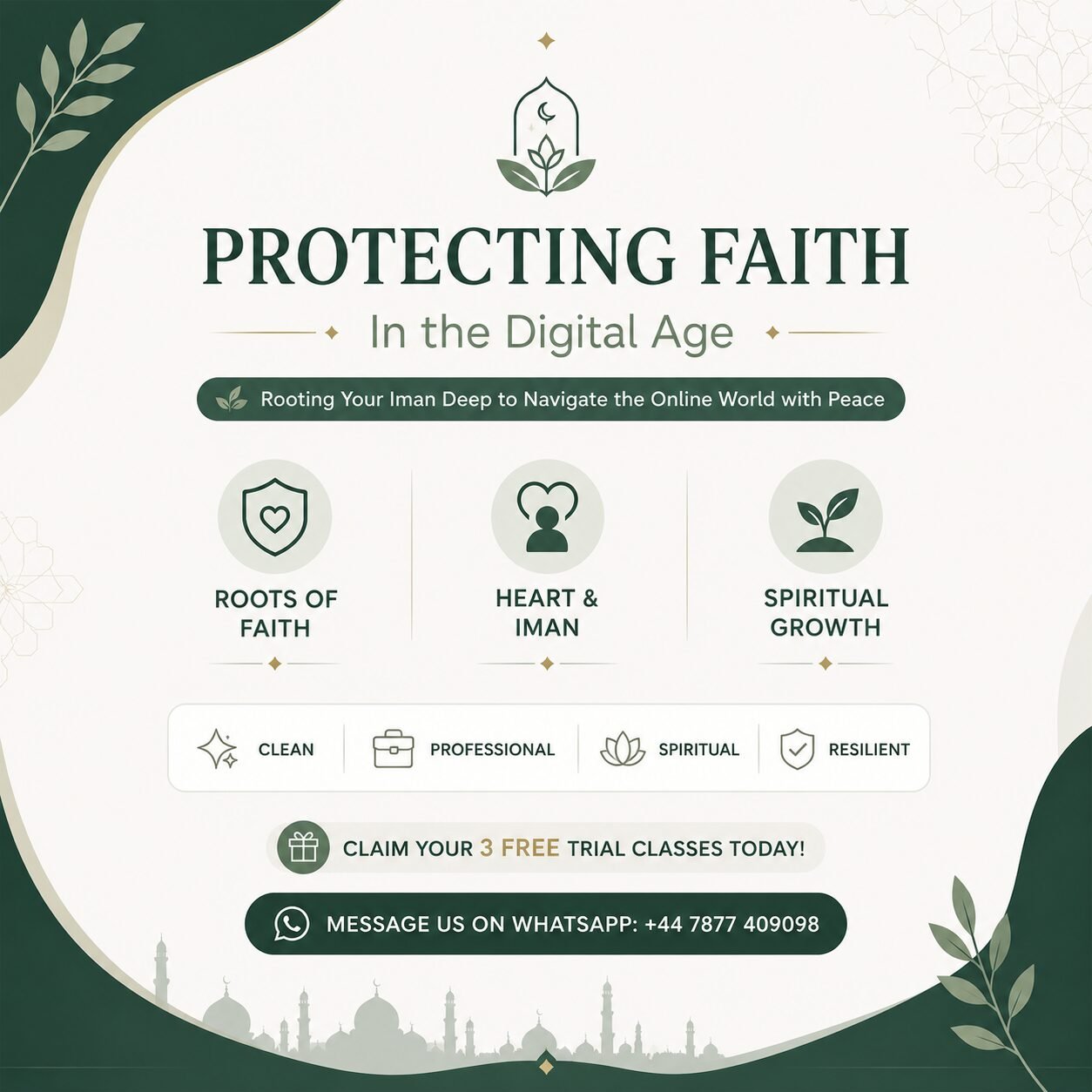
Protecting Faith
in the Digital Age
Rooting your iman so deep that no algorithm can reach the soil where it grows.
Digital distractions silently drain the depth from our Salah and Quran, one notification at a time.
Environment redesign, Digital Sunset before Isha, Digital Fasting on Fridays, and structured Quran learning.
Roots of iman so deep that no algorithm, feed, or notification cycle can uproot what you have grown.
The Five Branches of a Rooted Believer
Hover or tap each branch to receive its message
The Soil Has Changed
There is a tree in the heart of every believer — its roots plunge far beneath the surface, drawing nourishment from prayer, Quran, and remembrance of Allah. For centuries, that tree stood in quiet, open ground. Today, it must grow through concrete. Protecting Faith in the Digital Age is no longer an abstract theological concern; it is the most urgent gardening task of our generation.
The phone in your pocket is not evil. But it is relentless. Notifications arrive like shallow rain — frequent enough to feel productive, never deep enough to nourish. Meanwhile, the roots of Salah, Quran, and dhikr demand what social media was architecturally designed to prevent: stillness, depth, and sustained attention.
Research shows the average person unlocks their phone over 90 times a day. For a Muslim obligated to pray five times, that means the phone is checked roughly 18 times between every two Salah. The digital world takes no breaks during Fajr. It has no Adhan.
"Have you ever stood in prayer — in qiyam before Allah — while your mind was still scrolling through yesterday's Instagram feed? You are not alone. Most of us have been there. The question is: what do we do next?"
The Science: Dopamine & the Scroll Loop
Social media is engineered to hijack your brain's dopamine reward system. Every like, notification, and new post triggers a micro-hit of dopamine — keeping you in a loop of craving and checking. Over time, this rewires your brain to need novelty every few seconds, making sustained focus — like reciting Quran with tajweed — feel genuinely difficult, not because you lack willpower, but because your neurology has been conditioned otherwise.
The Deen: Dhikr as the Antidote
Hazrat Ali (R.A) said: "Do not let your time become worthless in your own eyes, for if it is worthless to you, it will be worthless before Allah." The scholars of Islam understood centuries before neuroscience that repetitive remembrance of Allah — dhikr — recalibrates the heart. Where dopamine chains the mind to a scroll loop, SubhanAllah anchors it to its origin. Dhikr doesn't just calm — it rewires.
"Protecting Faith in the Digital Age requires the patience a forester shows — you do not grow an oak in a season. You prepare the soil, protect the seedling, and return to it every single day." — On the nature of spiritual discipline in a distracted world
Real-Life Scenarios: Roots That Held
The following are real stories of Muslims who chose to tend their spiritual roots — and watched them grow stronger as a result.
Hana's "Salah-First" Phone Rule
Hana, a 24-year-old university student in Lahore, noticed she was opening Instagram every morning before even making wudu. Post-Fajr, instead of dhikr, she would scroll — and 45 minutes would vanish. She made one structural change: moved every social app off her home screen, placed the Quran app and a Salah tracker in their place, and enabled Do Not Disturb from Isha until 30 minutes after Fajr. Within three weeks, her post-Fajr Quran reading had grown from zero to one juz per week — not because she had more willpower, but because she had redesigned her environment. Protecting Faith in the Digital Age, she realised, means reshaping what the phone offers you first.
📖 Result: 1 juz per week within 3 weeks — zero extra effort, pure designYusuf's "Digital Sunset" Before Isha
Yusuf, a 38-year-old software developer and father of three in Karachi, struggled with Isha most. By 9 PM, after a full day of screens, his mind felt like overworked soil — compacted and unable to absorb anything spiritual. He introduced his "digital sunset": all screens off by 8:30 PM. He sat with his family, made tea, and recited Surah Al-Mulk before Isha. Within a month, his Isha prayer felt entirely different — present, unhurried, and alive. "I used to think I was tired of praying," he shared later, "but I was actually just tired of screens. When I separated them, the sweetness returned." Protecting Faith in the Digital Age, for Yusuf, meant giving his heart a chance to go quiet before standing before his Lord.
🌙 Result: Isha became the most anticipated part of his dayMariam's Quran Circle — Structured, Not Scrolled
Mariam, a 31-year-old teacher and mother in Birmingham, found that online Islamic content had deepened her love of Quran — but only after she learned to curate it. She had fallen into the trap of 40-second Islamic reels that felt productive but left her spiritually hollow. Her solution: online Islamic content only after completing her daily Quran reading, never before. She also joined a structured online Quran class with a qualified female teacher. The accountability did what willpower alone could not. Within four months, she had memorised three new surahs — something she had been "meaning to do" for seven years. Protecting Faith in the Digital Age is possible when the digital world becomes a servant of your spiritual goals, not their master.
📿 Result: 3 surahs memorised in 4 months after 7 years of tryingPractical Roots: Your Five-Point System
- Redesign your home screen. Make the Quran app easier to reach than Instagram. Environment beats intention every time.
- Use a physical prayer rug as a cue. Lay it out before the Adhan — give your body a spatial trigger that precedes any digital one.
- Set a daily Digital Sunset. Screen-free time 30–60 minutes before Isha creates mental soil fertile enough for deep, present prayer.
- Curate your feed ruthlessly. Unfollow anything that consumes attention without nourishing iman. Your feed should feel like a reminder, not a distraction.
- Join a structured learning community. A teacher transforms good intention into lasting habit. Accountability is the sunlight a sapling cannot grow without.
"When was the last time you completed a full Surah in one sitting — without once checking a notification? If that question stings a little, it means the roots need tending. That is not shame. That is growth calling."
Digital Fasting — A "Roza" for Your Screen
Just as Ramadan teaches the body to fast from food, the concept of Digital Fasting trains the heart to fast from screens. This is perhaps the most powerful and underused tool for protecting faith in the digital age. It is not about technology being haram — it is about reclaiming sovereignty over your own attention.
Jumma Digital Fast (Weekly). Every Friday, keep your phone on silent and in another room for 2 hours — starting 30 minutes before Jumu'ah and continuing 90 minutes after. Observe what returns to your heart in that silence.
Monthly 24-Hour Screen Sabbath. Once a month, go from Maghrib to Maghrib without social media. Not no phone — no feed. You will be surprised what your mind starts creating in the absence of consumption.
Morning Quran Window. The first 20 minutes after Fajr are a phone-free zone — non-negotiable. This is the most fertile soil of the day. Plant Quran in it before the world plants its noise.
The Evergreen Choice
An evergreen tree does not lose its leaves when winter arrives. It endures not because it is untouched by the cold, but because its biology was built for it. Protecting Faith in the Digital Age is the work of becoming evergreen — building a relationship with Allah so rooted in daily practice that the frost of distraction cannot strip you bare.
The digital age will not slow down. The notifications will not stop. But your roots can go deeper than any algorithm can reach — deeper than any feed, any trending reel, any dopamine loop. That depth is built one prayer at a time, one ayah at a time, one intentional choice at a time. And it is built far more effectively with a guide than alone.
Ready to Deepen Your Roots?
Have questions about our classes, schedule, or approach to Protecting Faith in the Digital Age? Our team is here — one tap away.
Message Us on WhatsApp · +44 7877 409098